


Table of Contents
Workplace communication is the exchange of information, ideas, and feedback between employees across verbal, written, nonverbal, and visual channels. Organizations with effective communication practices generate 47% higher total returns to shareholders than those with poor communication, while poor workplace communication costs US businesses up to $1.2 trillion in lost revenue every year. For large enterprises with distributed or frontline workforces, the gap between strong and weak communication is measurable in productivity, retention, and business outcomes.
Workplace communication shapes how employees share ideas, how businesses communicate strategies and goals, and how organizations respond to change. Approximately 60% of companies do not have a long-term strategy for their internal communications. Reviewing and updating a business’s communications strategy defines the direction and emphasis for idea creation and sharing that drives business results.
Key Insights
- Poor workplace communication costs US businesses up to $1.2 trillion in lost revenue every year due to inefficiencies, project delays, and unclear messaging.
- Organizations with effective communication practices generate 47% higher total returns to shareholders compared to those with poor communication.
- 57% of employees report not being given clear direction, and 69% of managers feel uncomfortable communicating with their employees.
- Effective workplace communication builds stronger professional relationships, increases productivity, and reduces costly mistakes across distributed teams.
- The four types of workplace communication, verbal, nonverbal, written, and visual, each require distinct communication skills and serve different organizational needs.
What is workplace communication?
Workplace communication is the structured exchange of information, feedback, and ideas between employees across an organization, conducted through verbal, written, nonverbal, and visual channels to support business goals and daily operations.
Communicating effectively is a critical aspect of getting any job done, whether it occurs in-person or virtually, and is part of the internal communications efforts within an organization.
Tracking internal communications metrics is a challenge for most communicators
Verbal communication
Verbal communication involves conveying information, feedback, or direction using spoken words, whether in meetings, presentations, or one-on-one conversations -in-person or online.. It is the most immediate form of workplace communication and the one most dependent on tone, body language, and context.
Nonverbal communication
Nonverbal communication conveys information through unspoken cues including body language, facial expressions, eye contact, and tone of voice. Paying attention to these nonverbal cues can have a greater impact on understanding than the words themselves, helping build trust between team members in face-to-face and video conferencing settings.
Written communication
Written communication includes emails, messages, reports, and any other form of conveying information in text. It remains the dominant channel in most organizations, with workers spending an average of more than five hours a day checking and answering emails.
Visual communication
Visual communication involves conveying information through charts, graphs, infographics, and images to enhance understanding and retention. It is particularly effective for presenting data, summarizing complex processes, and reaching employees who are more responsive to visual formats.
Organizations once relied primarily on in-person verbal communication, but the rise of hybrid and distributed work has shifted the balance toward written and visual channels. Today, 52% of remote-capable US workers are hybrid, and businesses need communication strategies that reach employees across every channel and location.
What do we mean by effective workplace communication?
Effective workplace communication is a two-way communication process in which the sender encodes a message with clear context, selects the appropriate channel, and the receiver decodes and confirms understanding through feedback. Both sides must communicate effectively for the exchange to produce results.
Establishing context as the sender, and choosing the proper medium or channel, is critical. Effective communication should always have a context that forms the setting and necessity for the statement, idea, or question being shared. Setting includes any external circumstances like urgency, opinions, or culture.
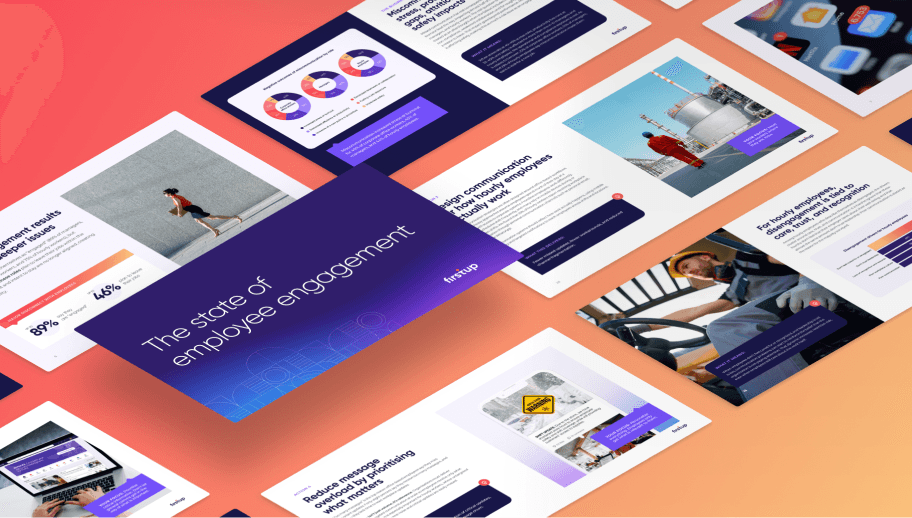
Firstup’s 2026 State of Employee Engagement report finds that 43% of corporate office workers and 37% of managers spend three or more hours each week searching for basic information they need to do their jobs.
The sender is another important aspect of effective communications. Messages are written based primarily on the medium that they travel through. It is the sender’s responsibility to encode the information or idea that they are trying to share so that it can be received.
The medium, or channel, is how the message is communicated — verbally, electronically, or on paper. Technology has improved the mediums available to communicate across the workplace. Communication channels today enable constant connection across teams, locations, and time zones.
Maximizing connectivity is one of the primary goals of any communication medium. According to McKinsey, employee productivity increases 20-25% in organizations where employees are highly connected. Connectivity requires high-performing platforms to facilitate idea sharing and conversations.
The final element to effective communication is the receiver. Receivers decode messages using context and observation to interpret information and create their own thoughts. Receivers provide feedback when they receive information, to confirm both receipt and understanding.
Sifting through data and information can be one of the most difficult aspects of being a receiver. When Adobe surveyed over 1,000 Americans working in offices, they found that workers spend an average of more than five hours a day checking and answering emails. Luckily, there are numerous technology solutions that offer stronger communication platforms than email-based communications.
For more details, download our State of employee engagement report here.
Measuring effective workplace communication
Once business leaders realize the importance of effective communication in the workplace, the next natural question is how to measure business communication effectiveness across the organization.
Measuring communication effectiveness can be difficult for businesses with employees working virtually. Without a physical representation of communication channels and networks, employees often forget who they are supposed to be communicating with on a daily basis.
Virtual communication tools and applications bring a workforce together by facilitating the number of connections. Every workplace is different, but across a business functional area or an organization, everyone should be able to connect with each other.
Communication between two or more people happens across a channel. The Communications Management section of the Project Management Book of Knowledge, written by the Project Management Institute, defines communication management as “the key to project control, communications management provides the vital project integrity required to provide an information lifeline among all members of the project team.”
Over the last 20 years, time spent on workplace collaboration and communication has increased by 50% or more. The increase in the quantity of communication must be paired with quality communication in order to be effective. This key tradeoff between information quantity and quality is critical to developing a communication platform in which employees are better off from the information and messaging they receive from their employer.
Effective communication practices also require strong communication skills at every level of the organization. Active listening, focusing fully on the speaker, processing the message before responding, and confirming understanding, is one of the most consistently cited techniques for good communication and improved communication effectiveness. Paired with the ability to deliver constructive feedback clearly and without ambiguity, active listening forms the foundation of clear communication in both individual and team settings. Matching communication style to the audience and channel reduces misunderstanding and increases the quality of the exchange.
Why workplace communication drives business results
Data has shown that employees with open communication and functioning communication networks in the workplace are more productive, have greater work-life balance, and have better mental health. Proper workplace communication increases productivity and creativity, and a comprehensive communications management plan should be a part of corporate and business strategy.
Effective workplace communication builds and maintains relationships across an organization. Relationships are managed by the key interactions that take place every day. Distributed and hybrid work models have created significant challenges for businesses in managing and building the relationships between their employees.
The first few weeks at a business are critical for building a new employee’s expectations and understanding of the work environment and goals of the organization. Effective workplace communication systems are key to solving the difficulties of virtual onboarding by creating an immersive platform and tiered engagement plan to bring new employees into the culture gradually and consistently.
Innovation also benefits from effective communication. According to Salesforce, 86% of employees and executives cite lack of collaboration due to ineffective communication as a main cause of project and product failures across industries. There are numerous communication tools and collaboration platforms a company can utilize to improve innovation and build stronger relationships across teams. According to a survey of over 1,000 employees, 39% believed that people in their own organization do not collaborate enough. Collaboration, and effective communication in general, helps businesses solve problems and perform through difficult periods.
Employee engagement is one of the clearest measures of whether communication is working. Gallup research shows that global employee engagement sits at just 20%, with managers accounting for 70% of the variance in team engagement scores. Organizations that invest in structured, two-way communication between managers and employees consistently outperform those that rely on top-down messaging alone.
Firstup’s 2026 State of Employee Engagement in North America report further finds that strong communication drives engagement for 52% of managers and 49% of corporate office workers, but for only 35% of hourly workers — pointing to a structural gap in how frontline teams experience workplace communication.
Emotional intelligence plays a significant role in communication effectiveness at every level. Emotional intelligence is the ability to identify, understand, and manage one’s own emotions as well as the emotions of others. Employees and managers with high emotional intelligence recognize nonverbal cues, respect different communication styles, regulate their responses under pressure, and build the psychological safety that makes open communication possible. Research consistently links emotional intelligence to reduced workplace conflict, stronger professional relationships, and higher job satisfaction.
Poor workplace communication, by contrast, carries measurable costs. Inadequate communication to and between employees costs organizations an average of $62.4 million per year, according to research by David Grossman. Ineffective communication stalls innovation and compounds the challenges already facing distributed teams.

Hyper-personalized comms for every employee
“We can send certain communications just to pilots, or in-flight tech ops, or airports, and also target by city or region—slice and dice the content so it’s appropriate for the team member.”
Improving communication in the workplace
Businesses must identify the cultural and environmental needs of their employees in order to improve workplace communication and align business communication with strategic goals. Effective workplace communication often starts with company leadership. A survey by Harris Poll found that 57% of employees report not being given clear direction and 69% of managers feel uncomfortable communicating with their employees in general.
A more recent Firstup study found that 70% of managers report challenges communicating effectively with their hourly teams, and only 29% feel confident their communication approach keeps workers compliant with required policies.

Establishing formal and informal communication channels is one of the best ways for a business to improve its workplace communication. Businesses can improve the quality of their communications by empowering managers to communicate effectively and upfront. Formal workplace communication channels are often the best route for managers to convey important company goals and initiatives.
Informal workplace communication channels are also vitally important for daily business operations. Senior management often ignores informal channels in their communications plans, but these channels account for the majority of day-to-day business communication. Communication platforms are effective solutions for facilitating informal communication between employees and management. Informal channels are also where businesses need to ensure proper adherence to company policies, ethics, and values. General principles of ethical communication are truthfulness, accuracy, honesty, and reason.
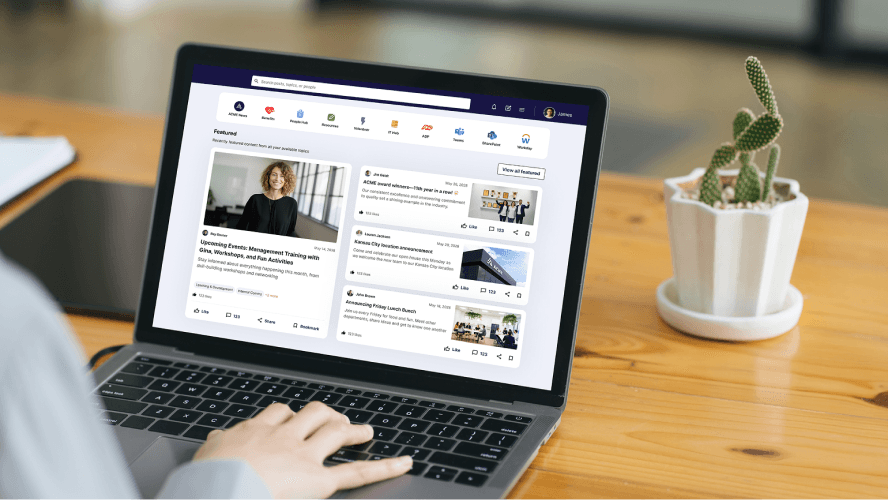
For enterprises with distributed, frontline, or shift-based workforces, improving workplace communication requires more than adding channels. It requires targeting the right message to the right employee at the right moment. When 61% to 67% of employees miss critical policy or procedural updates, and only 16% of hourly employees trust corporate leadership as a source of information, broader channels alone don’t close the gap. Firstup delivers personalized employee communications across app, email, intranet, digital signage, and MS Teams from a single platform — with targeting by role, location, shift, and behavior — so every employee receives information relevant to their work regardless of where or when they work.
The return on investment for your company
Return on investment is a performance measure used to evaluate the efficiency of an investment or its ability to create qualified positive returns. Management should look at workplace communication as a performance investment, and consistently assess whether their investments into it are paying off. Learn how to measure internal communications.
The cost of poor workplace communication is well documented. Poor communication costs US businesses up to $1.2 trillion in lost revenue every year due to inefficiencies and project delays. At the individual company level, a survey of 400 companies with 100,000 employees each cited an average loss of $62.4 million per company per year because of inadequate communication to and between employees.
Businesses that invest in workplace communication effectively often see dividends in their bottom line. Companies with effective communication practices generate 47% higher total returns to shareholders compared to organizations with poor communication.
The intangible benefits of investing in and establishing effective workplace communication can even outweigh the tangible benefits for the long-term strength of a business. Effective communication leads to healthier work culture and satisfied employees who deliver their best level of work and remain with the business longer.
For more details, download our State of employee engagement report here.
Table of Contents
Related posts
- 8 key components of a successful enterprise communication strategy
- 25 employee newsletter ideas to engage and improve your workplace
- Engaged but about to leave: What workers in North America and the UK are really telling us
- Choosing the Best Internal Communication Tools for a More Connected, Engaged Workplace
Subscribe via Email
Subscribe to our blog to get insights sent directly to your inbox.
Related posts



Sign up to receive the latest news and resources from Firstup
Firstup delivers personalized communication and data insights to improve the employee experience at every moment that matters