

Table of Contents
Why the portal model has reached its limit—and what it takes to move beyond it.
Every enterprise communications team has lived this moment: the message goes out, the dashboard says “delivered,” and everyone moves on. Then the safety drill is missed. The policy doesn’t get acknowledged. The open enrollment deadline passes with half the workforce still unenrolled.
The message was sent. But the action wasn’t taken. And somehow, the system counts that as a win.
That’s the fundamental problem with the intranet destination model: it was built to publish and deliver information, not to ensure that information leads to action. It puts the destination at the center and depends on employees to remember it exists, go looking for what matters, and figure out what they need to do next.
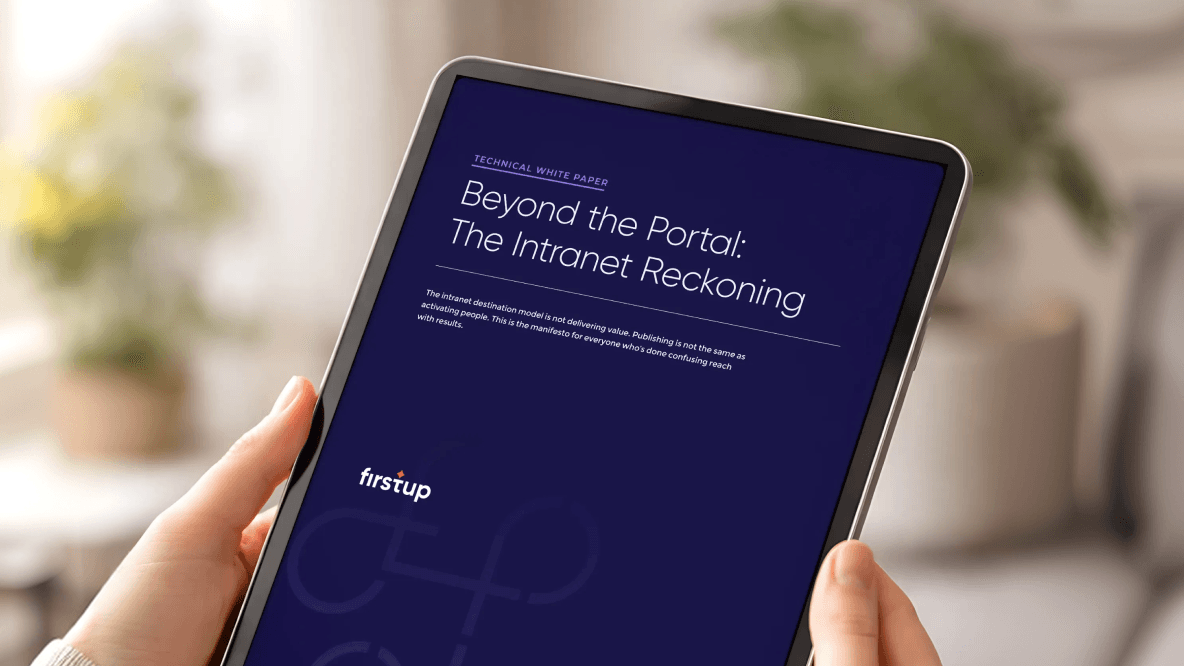
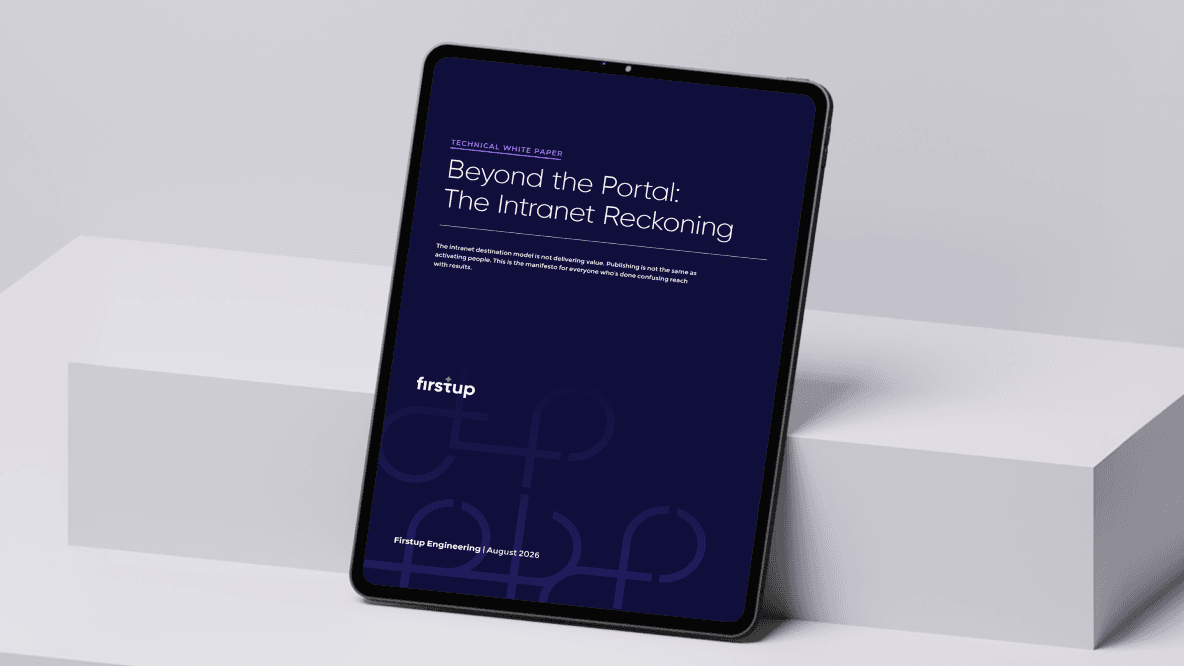
But getting the message out has never been the goal. What happens after the message is delivered is what matters. This is the argument behind our new paper, Beyond the Portal: The Intranet Reckoning.
The full paper makes the case in six points. Here’s the short version:
It's an action problem, not a volume problem
Most employees hear from their employer at least once a week, and 61–76% still say they missed an important policy or procedural update they were supposed to act on. So “communicate more” isn’t the answer. In fact, it may be making the problem worse. Gallagher's 2026 Employee Communications Report puts a number on where the profession stands: audience burnout is the number-one risk facing communicators, and information overload affects 83% of organizations—93% among enterprises with 10,000 or more employees. Pushing harder into a channel that already isn't landing just produces more noise.
The people this model fails hardest are the 2.7 billion frontline and deskless workers who run the global economy. A destination they have to remember, on a device many were never issued, in a moment they don't have, was never going to reliably reach a nurse on a fourteen-hour shift or a driver mid-route. For them, the destination model isn’t merely underperforming. It’s structurally incapable of doing the job we’re asking it to do.
A new UI is not a new model
The instinct every organization reaches for is to simply replace the old intranet with new features: a cleaner interface, better search, mobile responsiveness. Those are real improvements, but none of them change the underlying assumption that the critical information lives somewhere, and employees are responsible for going there to find it. Companies keep modernizing the destination without questioning why employees have to go looking for information in the first place.
Consumer brands confronted this problem decades ago. They stopped assuming customers would remember to visit a website and started using data to reach each person with relevant information in the channels and moments where they already were.
The result wasn’t a better website. It was a different model—one organized around the person instead of the destination.
Enterprise communication is due for the same shift.
The job isn’t to publish. It’s to activate.
Think about what organizations actually need communication to accomplish. Complete the training. Acknowledge the policy. Enroll in the plan. Take the shift. Follow the safety procedure. Understand the change.
Every one of those is an action. And behind those actions are the outcomes leadership actually cares about: retention, safety, productivity, efficiency, successful change. That changes what a communication platform has to do.
Instead of waiting for employees to find information, the platform needs to understand who each person is, what matters to them, what they’ve already seen and done, and what they need to do next. Then it needs to reach them in the right channel, at the right moment, and keep working until the action happens.
Doing that at enterprise scale requires four capabilities working as one system:
- a universal employee profile
- omnichannel delivery
- intelligent delivery to the moment of action
- outcome-based journey automation
Together, they create a system that keeps working until the action happens, not just until the message has been “sent.”
Purpose-built AI is what makes this possible at scale, but it has to be grounded in real employee data—the kind a destination-based model struggles to capture.
The economics are already in
If this were only a philosophical argument, it would be a different conversation. It isn’t.
Forrester Consulting's 2026 Total Economic Impact™ study of Firstup found that a composite 10,000-employee enterprise, 60% of them frontline, realized $8.9M in benefits against $1.8M in costs over three years—a 398% ROI with payback in under six months.
That value didn’t come from managing an intranet more efficiently. It came from real business outcomes: a 4% reduction in voluntary frontline attrition ($4.7M), hours reclaimed from searching for basic information ($2.3M), a 30% reduction in serious safety incidents by Year 3 ($1.1M), and a comms function made up to 30% more productive ($533K), plus another $336K in tool-consolidation savings from retiring redundant point solutions.
These are precisely the kinds of outcomes the destination model was structurally incapable of producing.
The only question that matters
For decades, we’ve asked whether the message was published. Whether it was delivered. Whether someone opened it, clicked it, or visited the page. Unfortunately, those metrics can’t tell you the thing that matters most.
Did anything happen next?
Did the employee complete the training? Acknowledge the policy? Enroll in the benefits? Take the shift? Follow the safety procedure? And did those individual actions add up to better retention, greater productivity, fewer safety incidents, or more successful change?
Reaching everyone is the starting line. Driving action and delivering the business outcome behind it is what counts.
Our new paper, Beyond the Portal: The Intranet Reckoning, makes the full case in six points, with the complete Forrester data and the architecture of what replaces the destination model.
Table of Contents
Related posts
Subscribe via Email
Subscribe to our blog to get insights sent directly to your inbox.
Related posts




Sign up to receive the latest news and resources from Firstup
Firstup delivers personalized communication and data insights to improve the employee experience at every moment that matters