


Table of Contents
First-year nurse turnover is a critical problem for healthcare organizations. It impacts cost, quality of care, and morale of the other nurses. According to NSI Nursing Solutions, first-year nurse attrition exceeds 22% and accounts for 29% of all RN attrition. And replacing a single bedside nurse costs more than $60,000. Effective nurse retention strategies start on day one, as the first few months are especially critical for retention.
Pay, scheduling, safety, and workload matter, and most health systems are working to address these issues. However, communication is often overlooked, even though it has a dramatic impact on nurse retention.
How much does nurse turnover cost?
Replacing one bedside nurse costs more than $60,000, and turnover can cost a hospital millions each year. The 2025 NSI National Health Care Retention & RN Staffing Report puts the average cost of turnover for a single staff RN at $61,110, up 8.6% from the prior year. NSI also reports that hospitals can lose between $3.9 million and $5.7 million annually to turnover alone.
What’s causing nurse attrition? Why do new nurses leave in the first year?
The Wall Street Journal reported that nurses are leaving the profession for a variety of reasons, including stress, burnout, and concerns about personal safety. Communication challenges exacerbate the situation.
In Firstup’s State of Hospital Communication survey of 1,000 U.S. hospital nurses, 81% reported patient care issues caused by organizational miscommunication. The same survey found that 52% of nurses named miscommunication as a source of stress or burnout, 32% said it made them want to leave their current unit, and 21% said it made them want to leave nursing entirely.
Hospitals are trying to communicate with nurses—they just aren’t doing so effectively. Nearly 70% of nurses in Firstup’s survey received workplace updates several times a week or more, and yet they still miss things for three reasons:
• Channels don’t fit the work. Email is the dominant channel at 86% of hospitals, yet nurses spend 12-hour shifts on their feet, and 25% still receive paper notices.
• Relevance is low. 48% of nurses said the communications they receive are only somewhat relevant to their role, and 39% said they aren’t relevant at all.
• Important updates get missed. 67% admitted to skimming or deleting workplace updates without fully reading them at least sometimes. As one nurse put it, “A pointless motivational notification looks just like an important policy.” And 90% of nurses said they had learned about a workplace policy after it took effect at least once.
For a new nurse still forming an opinion of the organization, a missed or irrelevant message can feel like a sign that their employer or manager doesn’t care about their well-being.
When do new nurses decide whether to stay?
At Nebraska Medicine, new employees reached a critical juncture around three to four months in, according to Paul Baltes, interim Vice President of Marketing and Communications at Nebraska Medicine. He described that time period as a “division point,” when people decide whether the organization is a good place to work or start looking elsewhere.
Nebraska Medicine timed its onboarding content to that window, with reminders about benefits, development programs, and reasons to stay. Orientation ends long before month three, so support has to continue well beyond that.
Why Chief Nursing Officers and nurse managers can’t carry the whole communication load
Frontline staff trust their managers more than any other source, but managers can’t relay every message across every shift and unit. In Firstup’s State of Employee Engagement in Healthcare report (based on a survey of 718 healthcare and pharmaceutical employees across North America), 43% of hourly healthcare workers named their direct manager as their most trusted source, compared with 16% who named senior leadership. Only about 24% of managers said they were highly confident that current communication approaches keep frontline workers compliant with required policies and procedures, and lack of time was their biggest barrier to engaging hourly workers.
Managers already have the trust. What they lack is time, so an intelligent communication system should handle routine messages and leave managers free for the conversations only they can have.
What are effective nurse retention strategies?
Firstup’s approach is a structured and automated first-year journey that reaches nurses on their preferred channels and supports them at set milestones. Here is what one might look like:
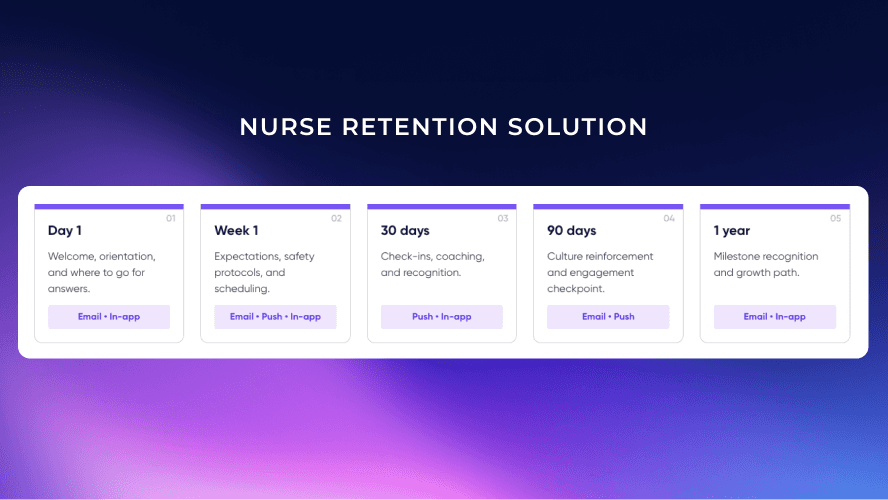
It rests on five practices:
• Meet nurses on mobile. Push notifications, in-app content, and email reach nurses on the floor, not just at a workstation.
• Trigger communications automatically. When a journey draws on HRIS data such as start date, nobody has to remember to send the 30-day check-in.
• Build in the manager. Prompts for check-ins, coaching, and recognition give managers a timely way to step in before a small problem becomes a reason to leave.
• Surface growth and belonging. Development programs, mentorship, benefits, and employee resource groups should appear throughout the year, not only in a benefits packet.
• Listen and adapt. Pulse surveys and engagement analytics show where nurses are struggling and make communication two-way. One nurse in Firstup’s survey described the alternative this way: “Why even try to engage? [It] does not lead to any meaningful changes.”
Firstup’s Nurse Retention solution packages these practices into a preconfigured 12-month journey built on Journey Orchestration. Draft content is 80 to 90% complete, so teams customize the remaining 10 to 20% for their brand, workforce, and programs instead of starting from a blank page.
What results have health systems seen?
Nebraska Medicine, an academic health system with more than 10,000 employees, saw first-year turnover fall 15% year over year, with an even larger decrease among nurses. The organization had been losing more people than it was hiring. HR and marketing worked together to listen to employees, refresh the employment brand, and launch an automated onboarding journey in Firstup, triggered through Workday and spanning employees’ first year.
According to The Josh Bersin Company’s Nebraska Medicine case study, results between June 2023 and June 2024 included:
• 16% decrease in voluntary turnover year over year
• 15% decrease in first-year turnover
• 10% decrease in total turnover
• 22% increase in external hires
These results reflect a broader effort that also included an employment brand refresh and onboarding improvements.
What is the ROI of improving retention through communication?
In a commissioned Forrester Consulting study, a composite 10,000-employee organization saw a 398% ROI and $8.9M in total benefits over three years. The Total Economic Impact™ of Firstup, conducted by Forrester Consulting on behalf of Firstup in June 2026, found:
• $4.7M saved with a 4% reduction in frontline attrition
• $8.9M in total benefits
• 398% ROI, with payback in less than six months
Retention was the largest benefit category. Separately, in a Forrester healthcare spotlight, one organization that built Firstup-supported communications into onboarding saw a 12-percentage-point improvement in retention for new frontline employees in one department. Forrester notes that results will vary by organization.
Where should health systems start?
A practical way to begin:
- Evaluate what kind of culture you are trying to build and how you can use communication to reinforce the desired behaviors and outcomes
- Look at first-year attrition by unit and tenure. Where are nurses leaving, and when?
- Map the milestones. Day 1, week 1, 30, 90, and 365 days make a good start, with extra attention to months three and four.
- Equip your managers with timely prompts and tools so support doesn’t depend on individual capacity.
- Measure business outcomes such as retention and engagement, not just what gets sent.
Every new nurse who stays through year one is one less vacancy to backfill and one more familiar face on the unit.
See how the Firstup Nurse Retention solution can help your health system give every new nurse a stronger start.
Related resources: State of Employee Engagement in Healthcare | Firstup for Healthcare | Modernizing healthcare communication: 398% ROI
Sources: NSI Nursing Solutions, 2025 NSI National Health Care Retention & RN Staffing Report; Press Ganey, The Nurse Work Environment 2024; Firstup, State of Hospital Communication Survey (n=1,000 U.S. hospital nurses); Firstup, State of Employee Engagement in Healthcare (June 2026, n=718); Forrester Consulting, The Total Economic Impact™ of Firstup (commissioned by Firstup, June 2026); The Josh Bersin Company, Nebraska Medicine Elevates Its Employee Experience with a Modern Marketing Approach (2025).
Table of Contents
Related posts
Subscribe via Email
Subscribe to our blog to get insights sent directly to your inbox.
Related posts




Sign up to receive the latest news and resources from Firstup
Firstup delivers personalized communication and data insights to improve the employee experience at every moment that matters