

Table of Contents
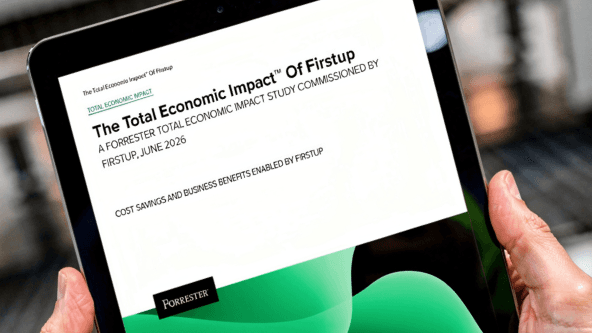
398%. That’s the return on investment calculated for an organization using Firstup as its primary workforce communications solution.
It is not an estimate from an internal champion trying to justify a budget. It’s a finding from an independent, third-party Total Economic Impact™ (TEI) study based on interviews with five enterprise organizations across healthcare, manufacturing, IT distribution, and retail.
For anyone who has ever walked into a budget meeting armed with nothing but conviction, that number matters. And these do, too: $8.9 million in total benefits for a company with 10,000 employees, and payback in less than six months.
> Read the entire TEI study and see for yourself
That last figure deserves particular attention. Less than six months is exceptional, and it reflects something important about the nature of workforce communications as an investment category. The benefits can begin accruing immediately across every part of the organization that depends on their employees being informed, connected, and engaged.
Where does the value come from?
The TEI methodology traces value across five distinct benefit categories, each grounded in data from real customers, and applied to a composite model representing a 10,000-person organization
Retention: $4.7 million
This is the largest benefit category, and for good reason. The study found that Firstup-enabled communication initiatives contributed to a 4% reduction in voluntary turnover of skilled frontline employees over three years. At an average replacement cost of $40,000 per employee, and up to $60,000 in healthcare, the avoided costs add up fast.
"Had we not had Firstup, I do not believe our other retention initiatives would have been nearly as successful as they were."
– VP, People Operations, Healthcare
Another healthcare organization studied a 16% year-over-year decrease in voluntary turnover and a 15% reduction in first-year turnover, with an even greater reduction among nurses.
Productivity: $2.3 million
When 6,000 frontline employees each save six hours per year searching for information, and 4,000 desk-based employees each save two hours, the impact scales quickly. Across three years, that adds up to 69,000 hours recovered and $2.3 million in productivity value returned to the business. But you can only save employees time finding information if you can reach them in the first place.
"We're able to reach nearly 90% of our frontline workforce, which we couldn't do before."
– Assistant Director of Communications and Marketing Operations, Healthcare
One IT distribution leader described the downstream effect: Firstup became "the digital front door to all company resources, which has drastically reduced time spent searching across tools."
Safety: $1.1 million
For organizations with significant frontline populations, this may be the most operationally meaningful finding. Interviewees experienced a 20% reduction in serious safety incidents in year one, growing to 30% by year three, as more consistent and targeted safety communications reached the right people at the right time.
"In every major event category, roughly 30% of harm-reduction events were directly attributable to Firstup-enabled studying. From a C-suite perspective, Firstup essentially paid for itself because catching 30% more errors before they reach patients changes both risk and cost."
– Chief Innovation Officer and Physician, Healthcare
For some organizations, the impact runs even deeper. A manufacturing communications leader studied a 35% decrease in serious injuries, exceeding the composite model's year-three projection, and a reminder that the TEI numbers reflect a conservative estimate across multiple organizations.
Communications efficiency: $533,000
The study estimated more than 12,000 hours saved across communications teams and content creators over three years, valued at $533,000. But the more significant shift interviewees described wasn't just about hours. It was about what those hours were spent on instead.
"We've shifted from being very tactical to being strategic communications advisers for our leaders. Previously, leaders would give us the message, and we'd copy, paste, and send it. Now we're actually helping shape the message."
– Director of Employee Communication and Digital Platforms, IT Distribution
One manufacturing communications lead estimated nearly 3,000 hours saved annually by creating content once instead of building the same message in four different systems.
Tool consolidation: $336,000
By retiring a fragmented mix of email platforms, intranet tools, digital signage systems, and mobile apps that preceded Firstup, organizations eliminated approximately $150,000 in annual legacy technology licensing costs. Over three years, that translated to $336,000 in savings while simplifying the technology environment for IT teams.
"Instead of fragmented tools and overlapping platforms, we now have a single governed system which eliminates redundancy and inefficiency."
– Director of Employee Communication and Digital Platforms, IT Distribution
The cost of maintaining the status quo is not zero
Every benefit figure represents money organizations were already losing before they made the investment.
The interviewees described a reality that will feel familiar to most large employers. Messages went to managers with the expectation that they would cascade down to frontline workers, often with no visibility into whether critical information ever arrived. Communications teams rebuilt the same message across multiple systems. Employees hunted across disconnected tools to find information relevant to their roles. Safety alerts moved slowly. Turnover climbed.
One healthcare communications leader described it plainly:
"We were often crossing our fingers and hoping critical information made it to the people who needed it most."
Crossing your fingers has a price. It shows up in the turnover numbers, safety incident studies, engagement surveys, and the hours spent on manual processes that should have been automated years ago. The TEI study makes that price visible and puts it in the same units as every other business investment: dollars and percentages.
The business case is built
For HR and communications leaders who have spent years making the qualitative argument for workforce communications investment, the Forrester TEI provides something many have lacked: an independent, rigorous framework that quantifies the value of a connected workforce, in precise financial terms.
398% ROI. $8.9 million in total benefits. Payback in less than six months.
The numbers are here. The business case is built.
Table of Contents
Related posts
Subscribe via Email
Subscribe to our blog to get insights sent directly to your inbox.
Related posts



Sign up to receive the latest news and resources from Firstup
Firstup delivers personalized communication and data insights to improve the employee experience at every moment that matters