


Table of Contents
The best employee newsletter ideas include new hire profiles, recognition and birthdays, training and career development, employee surveys, and interactive content like polls, contests, and staff spotlights. A strong employee newsletter mixes need-to-know company updates with engaging, human stories so people actually open and read it.
Originally published June 2022. Fully updated July 2026.
An employee newsletter is one of the few internal communications channels that still reaches everyone, no matter where or how they work. Done well, it informs employees, builds company culture, and gives your whole workforce a single place to catch up. Done badly, it gets ignored.
This guide explains what an employee newsletter is and why internal newsletters still matter in 2026. It then shares the best 25 employee newsletter ideas to engage employees and boost employee engagement across the company. These internal newsletter ideas work whether you publish weekly or monthly, and the closing FAQ answers the practical questions internal communicators ask most often.
Key Insights
- Global employee engagement fell to 20% in 2025, the lowest level since 2020, costing the world economy an estimated $10 trillion a year.
- 67% of internal communicators name email newsletters one of their most valuable channels in 2026.
- Managers drive roughly 70% of the variance in team engagement, yet only 22% of managers are engaged.
- 55% of organizations have 100 or more frontline workers, and 72% rate frontline engagement as important.
- A consistent, segmented, mobile-first newsletter that mixes need-to-know updates with human stories outperforms a one-size-fits-all broadcast.
What is an employee newsletter?
An employee newsletter is a company-wide digital communication shared only with company employees, designed to keep workers up to date and engaged with the organization. It is the curated anchor of your internal communications, pulling scattered updates into one predictable, scannable place.
A company newsletter can carry important company news, project updates, customer stories, upcoming company events, job postings, team member updates, and company milestones. Basically, it delivers any relevant information your entire workforce needs in one send.
Employee newsletters range from fun and light to serious and time-sensitive. Whether they come from the leadership team, human resources, department heads, or the marketing team, the purpose is the same: encourage employees to take an interest in what is happening across the organization. When team members feel in the know, they tend to be more productive, happier, and more loyal to the company.
Why employee newsletters still matter in 2026
Engagement has fallen to a record low. According to Gallup’s State of the Global Workplace 2026 report, global engagement dropped to 20% in 2025, down from a 23% peak in 2022. Low engagement now costs the world economy an estimated $10 trillion a year in lost productivity. In that environment, a consistent employee newsletter is one of the cheapest, highest-leverage tools an internal communications team has.
Email remains the backbone of how organizations reach people. ContactMonkey’s Global State of Internal Communications 2026 report found that 67% of internal communicators name email newsletters one of their most valuable channels, ahead of intranets and in-person events. The same research shows messages still get missed, which is exactly the gap a well-built company newsletter closes.
A good employee newsletter helps keep employees informed about the latest company updates. Whether the topic is client wins, monthly goals, personnel changes, or company announcements, a single internal newsletter ensures your entire team stays on the same page.
That alone helps inform employees faster than a string of one-off emails, no matter where they sit.
It also builds company culture and a sense of community. A newsletter is a natural place to recognize contributions, highlight different locations and perspectives, organize get-togethers, and run friendly competitions.

That connective tissue matters. ContactMonkey’s 2026 research found 46% of communicators cite low employee responsiveness as a major challenge, a gap a shared internal newsletter is well placed to close while strengthening workplace culture.
Connection drives performance, and managers are the linchpin. Gallup’s 2026 research finds managers account for roughly 70% of the variance in team engagement, yet manager engagement itself has slipped to 22%.

By sharing your company values, wins, failures, and challenges in an easy-to-read employee newsletter, and by equipping managers to pass it on, you help teams feel involved, heard, and motivated. That builds employee morale and loyalty over time.
A strong employee newsletter is not only a broadcast. Built well, it gathers employee feedback through embedded polls and surveys, surfaces employee concerns before they grow, and shows leadership is listening.
It can also connect daily work to strategic priorities, so people see how their effort ladders up to the wider strategy. That two-way loop turns internal newsletters from a notice board into a driver of trust.
Newsletters also reduce communication overload. Between chat tools, video calls, and a constant stream of email, workers are buried in messages, and the important updates get lost.

Bundling them into one company newsletter means higher engagement on what matters, instead of an avalanche of separate notices.
Finally, a newsletter reaches deskless and remote workers who are easy to leave out. ContactMonkey’s 2026 data shows 55% of organizations have 100 or more frontline workers, and 72% rate frontline engagement as important.

A mobile-friendly employee newsletter fills everyone in on birthdays, new hires, company initiatives, and promotions. It also invites them into contests, pulse surveys, employee profiles, and user generated content, so every employee feels part of the team. The format does the heavy lifting, reaching people on whatever device they already carry.
The single biggest problem in communication is the illusion that it has taken place. (George Bernard Shaw)
See where engagement really stands
Get the data your employee newsletter strategy should be built on.
Best 25 employee newsletter ideas to try today
The strongest internal newsletters balance employee focused content with company-focused content. Need-to-know items like company announcements and important company news earn the open, while engaging content like employee spotlights, fun facts, and employee generated content keep people reading.
Here are the best employee newsletter ideas to keep employees engaged. Mix these internal newsletter ideas so each issue has something for everyone.
1. New hire profiles and farewells
Welcome new hires with short blurbs that introduce them to the team. Highlight their role and background, and let them write a little about themselves so their personality shines through. At Firstup, new employees share three interesting facts about themselves, and a warm send-off for someone leaving on good terms is a classic employee newsletter touch. Welcoming new employees well sets the tone for everything that follows.
2. Mention birthdays and anniversaries
Quick notes on birthdays, work anniversaries, or personal achievements make internal newsletters more personal and more fun. Most people appreciate the gesture, and it is a simple form of employee recognition that scales across the whole company without a big budget. Pair it with a one-line note from a manager and the moment lands even better.
3. Introduce training and career development opportunities
If you offer stipends, courses, or events, the employee newsletter is a great way to keep everyone current. Share training sessions, conferences, webinars, and certificate bonuses so professional development and career development opportunities stay visible. Tie them to employee growth and your strategic priorities so people see a clear path forward. Even a two-line roundup signals that the company invests in its people.
4. Highlight recent employee vacations
Vacations help people recharge and avoid burnout, so let employees share where they went. Employee generated content like vacation photos and short travel notes makes for a fun, low-effort employee newsletter segment that encourages others to take their time off too. It costs nothing and reminds the team that downtime is expected, not earned.

5. Include internal job postings
Posting open jobs in your internal newsletter gives loyal existing employees first dibs on growing their career, and encourages them to refer people they know. Surface new job openings to internal teams first, because internal job boards promote internal mobility, which is far cheaper than external hiring. A short note on what the role involves and who to contact lowers the barrier to applying.
6. Remind employees of referral programs
If your company offers a referral bonus, make sure every employee knows about it and remind them now and then in the employee newsletter. Referrals are often the fastest way to find your next great team member, so keep the program top of mind with the bonus amount and how to submit a name. A single line every few issues is enough to keep it active.
7. Write up favorite staff recipes
If you have a budding chef on staff, let them share a favorite recipe. Make it a recurring feature and the team will check each issue to see what user submissions are cooking up. A photo of the finished dish and a one-line story behind it is plenty, and it is easy to source. Readers will turn up each issue just to see what is on the menu.
8. Showcase positive press coverage
Sharing positive press coverage with the whole organization helps people see the impact of their work. Featuring positive press coverage of your product, service, or brand lets everyone feel a sense of pride and accomplishment. Pair it with customer success stories so employees connect their effort to real outcomes. A short pull quote from the coverage makes the win feel concrete.
9. Pets are family too
Everyone loves a pet photo. Since pets are part of our families, why not make them part of the work family? If you want to know which employee newsletter content earns the most engagement, add a few pet photos and watch the reactions climb. For many teams it is the single most reliable engagement driver they have.

10. Run an “on the grapevine” rumor-control section
Rumors spread through a company quickly. Use your employee newsletter to verify what is true and dispel what is not. A short, honest myth-busting block builds trust faster than silence, and it gives employee concerns a constructive outlet during periods of change. Naming the rumor directly, then answering it, beats pretending it does not exist.
11. Share top ten roundup lists
Top 10 lists are easy to make and fun to read. Top 10 local lunch spots, songs, books, or productivity tips all make for great employee newsletter ideas. Let readers vote on the next list and you turn a passive read into a quick moment of participation.
12. Remind employees of special offers and employee benefits
If your company has perks beyond the standard employee benefits package, such as restaurant discounts or partner offers, be sure to inform employees. Use the same slot for benefits enrollment reminders so no one misses a deadline or a deal they would have wanted. Small, practical perks often get more clicks than big announcements.
13. Hold “guess the desk” contests
We are not all side by side in an office anymore, but we can still get a peek at how coworkers work. Run a contest where employees guess whose desk or home office setup is in a photo. It is a light way to connect remote workers and in-office staff, and you can reveal the answer in the next issue. Keep entries opt-in so no one feels put on the spot.

14. Invite guest editors
To really engage employees, offer them the chance to guest-edit an issue. Everyone builds an employee newsletter differently, so each guest edition brings a fresh voice and keeps the format from going stale. The variety alone gives readers a reason to open the next issue.
15. Highlight staff-recommended books, movies, and shows
A staff-recommendation column is an easy way to get people talking. Split it by department or open it to the whole company, and you will spark conversations that cross teams and strengthen workplace culture. It is also a low-cost way to fill space in a week when hard news is thin.
16. Share “this day in history” company news
Share company-specific milestones: when the company started, when a long-time team member joined, or when a major benchmark was met. This kind of company history helps newer team members understand how the organization grew before they arrived. It quietly reinforces the values that got the business to where it is.
17. Tell a few clean jokes
Dad jokes make people groan, but they land. Drop a clean joke into the employee newsletter now and then to hear the whole company sigh in unison. Small moments of levity keep an internal newsletter from feeling purely transactional. Rotate who picks the joke so the feature never goes stale.
18. Feature interesting podcasts
Share podcasts you think the team would find useful, funny, or motivational. It is an easy knowledge sharing feature, and you never know what employees learn and bring back to work. A one-line note on why you picked it helps people decide whether to press play.

19. Send employee surveys and pulse surveys
If you have not set up an employee listening program, you are missing one of the best ways to increase engagement. Embedded pulse surveys and anonymous answer boxes let team members submit questions anonymously, give you honest employee feedback, and encourage participation from people who would never speak up in a meeting.
20. Communicate policy changes
Mass emails about every policy change tend to go unread. It is easier for employees to digest a clear employee newsletter section dedicated to policy updates. Summarize the change, link to the full detail, and say what people need to do next. A clear before-and-after framing removes the wave of follow-up questions a vague notice creates.
21. Include employee calendars
Keep employees up to date on holidays, special occasions, and company-wide days off for the week, month, or quarter. A simple calendar block reduces back-and-forth and missed dates, and linking each date to the relevant page saves a search later. Highlight anything that needs an action, such as a benefits or enrollment deadline.
22. Provide easy-to-share content
An internal newsletter is a simple way to give workers shareable content. By preparing posts that fit different social platforms, you make it easy for people to amplify your message. Drop in ready-to-use captions so sharing takes one tap rather than ten minutes of rewriting. Allowing employees to help build your brand, a form of brand advocacy, goes a long way toward your success.
23. Showcase volunteer and do-good opportunities
If your company supports paid time off for volunteering, list upcoming volunteer opportunities and company events people can join. Volunteering turns abstract company values into something concrete, making a core value visible in a way a poster never can. Photos from the last outing do more to drive sign-ups than any reminder.

24. Offer health and wellbeing resources
Burnout and stress remain high across the workforce. Offer wellness tips, stress management techniques, and work life balance advice, along with links to free resources and reminders about mental health benefits. Including these in your employee newsletter signals that you genuinely care, and you can point to a fuller workforce wellness program. Frame every resource as an option, never an obligation, so it reads as support rather than pressure.
25. Promote company events
Last but not least, cover upcoming company events. Keeping employees informed about chances to connect with coworkers matters more than ever now that so many people work remotely. Give people plenty of notice so they can plan to take part. With travel and in-person gatherings picking up again, a clear heads-up is what turns interest into attendance.
Want to turn these ideas into measurable results? Pick three to pilot next month, set a clear baseline, and watch how participation moves from one issue to the next.
How to promote your employee newsletter and ensure it gets read
Even a great employee newsletter can go unread if people do not know it exists. Promote it across the channels your team already uses, and make reading it a habit rather than a surprise.
- Post about it in your workforce communications platform and pin it where people gather.
- Use digital signage and QR codes to reach frontline workers who lack a corporate inbox.
- Link to the latest issue and signup in your company chat channels
- Encourage employees to add the signup link to their email signature.
- Send a short company-wide email introducing the newsletter and what to expect.
To keep read rates high, follow a few internal newsletters best practices. Send on a consistent cadence, since inconsistency loses readers faster than infrequency.
Use templates to speed up production, and use audience segmentation when not everyone needs the same message. These best practices keep your company newsletter habit alive.
Allowing employees to contribute employee focused content keeps it from feeling top-down. To increase engagement, add clear calls to action for voting, surveys, and comments, then track click through rates to see what works.
Timing matters too. Mid-week mornings tend to see the strongest open and click through rates, while sends after 5pm get read less. Test send times against your own audience, keep subject lines short and benefit-led, and always preview on mobile before you hit send. One broken link or a subject line cut off mid-phrase is enough to lose the open.
Most of all, keep the employee newsletter tied to your company’s goals. The point of internal newsletters is to inform, engage, and motivate team members to do their best work, which supports business growth.
If every issue delivers real value and helps keep employees informed, people keep coming back. Consistent internal newsletters reinforce your company values, welcome new hires, and give your internal communications far more impact than a one-off email ever could.
Ready to benchmark your own program?
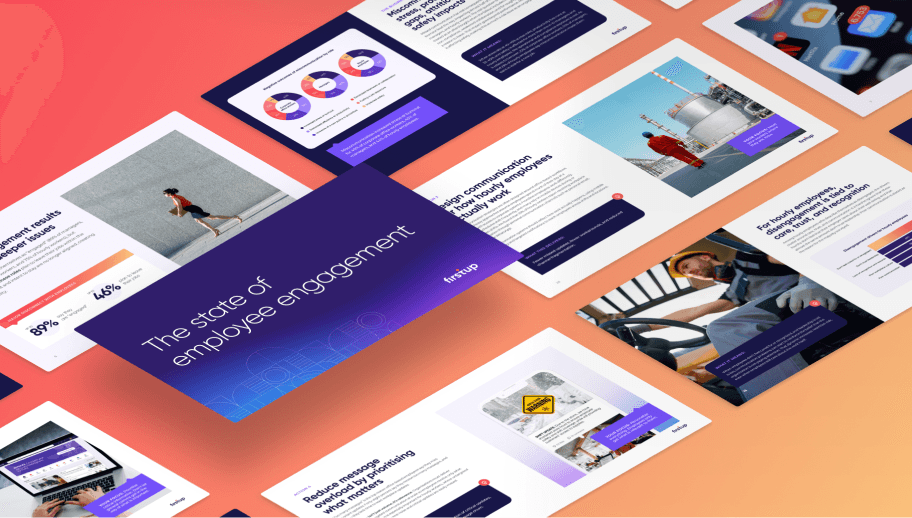
See how your engagement compares in the 2026 State of Employee Engagement Report.
Need more than ideas? Firstup’s digital employee experience platform reaches, engages, and connects every worker, and our guide to employee email best practices covers how to make each send land.
Book a demo to see how our digital employee experience platform can reach, engage, and connect every worker, everywhere, improving the employee experience and driving change.

Frequently asked questions
Table of Contents
Related posts
Subscribe via Email
Subscribe to our blog to get insights sent directly to your inbox.
Related posts


Sign up to receive the latest news and resources from Firstup
Firstup delivers personalized communication and data insights to improve the employee experience at every moment that matters