
Table of Contents
Just-published Firstup research surveying more than 6,200 workers reveals a troubling disconnect between how employees say they feel, and what they plan to do next.
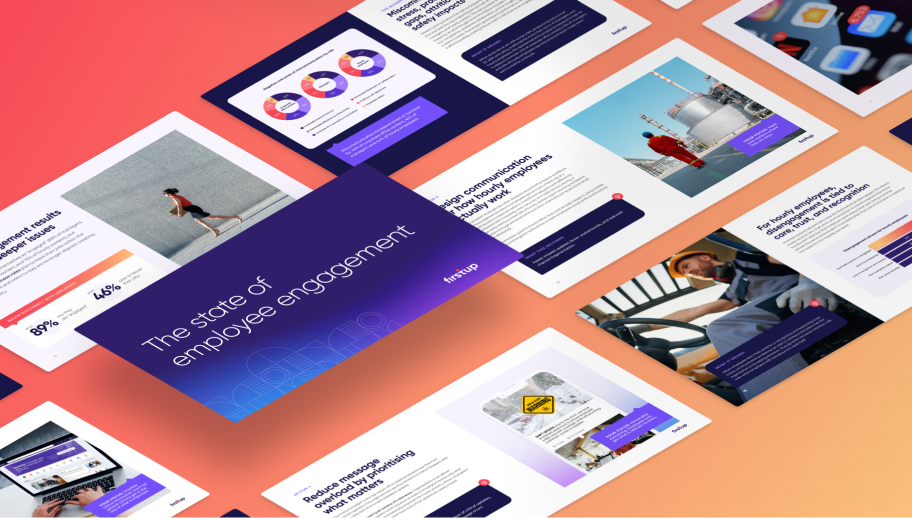
Ask most workers whether they're engaged at their jobs, and the majority will say “Yes.” That's exactly what Firstup found when it surveyed more than 6,200 employees across North America and the United Kingdom for its 2026 State of Employee Engagement Reports. The numbers look reassuring on the surface: up to 89% of managers, 82% of North American corporate office workers (76% in the UK), and 75% of North American hourly employees (69% in the UK) describe themselves as “engaged” or “highly engaged.”
But buried beneath those headline figures is a finding that should give every HR and communications leader pause: roughly half of those same engaged employees say they're likely to start looking for a new job within the next twelve months.
"This disconnect means that engagement alone is no longer a reliable signal of workforce stability. Organizations must do more to deliver critical information in a consistent, targeted, and measurable way, especially to the frontline. When employees have to work just to stay informed, engagement can quickly shift to burnout and loss of productivity, not loyalty."

A quick look at the numbers behind the disconnect
The gap revealed between engagement and intent to stay is striking when you look at the specifics. In North America, 40-46% of corporate office workers, managers, and hourly employees say they're likely to job-hunt this year, even among those who consider themselves engaged. (In the UK, the numbers are similar.) Among workers who describe themselves as not engaged, that figure surges to nearly 80%.
In other words, engagement surveys are measuring sentiment in the moment, not predicting whether someone stays.
One problem is a communication infrastructure that isn't working
Across both regions, the data points to a structural problem in how organizations deliver information. It's not a volume issue; most employees say they receive updates from their employer at least weekly. The problem is effectiveness.
Globally, between 61% and 67% of workers across roles report having missed an important policy or procedural update. In North America, roughly half of managers and hourly workers say their employer simply doesn't have an effective way to share information with them; in the UK, that figure climbs to 48–55%. Messages get buried in the noise, scattered across too many channels, or delivered through systems that don't match how employees actually work.
The business impact of miscommunication is measurable and broad
Miscommunication drives stress for an average of 43–44% of workers, productivity loss for 32–40%, and missed policy updates for 29–36%. Between 5% and 12% of employees say communication failures have created safety risks in their work environment, a statistic that reframes this as an operational and compliance issue, not just an engagement one.
It’s no wonder that roughly one in four employees say miscommunication has made them want to find a new job.
The time drain is also significant
On average, more than a third of corporate office workers and 37% of managers say they lose three or more hours every week just searching for basic information they need to do their jobs.
Managers: The most trusted and the most overloaded
At the center of this dynamic is a group that is simultaneously the most relied upon and the most overstretched: frontline managers.
Across both regions, direct managers are the most trusted source of workplace information. By comparison, only 11–23% of workers across the two studies say they trust leadership, and a similarly small share trust HR.
This trust in managers makes sense. They're closest to the day-to-day work. But it creates a dangerous dependency on a group already stretched thin. When critical communication flows primarily through managers, consistency breaks down across shifts, teams, and locations. And managers themselves are struggling.
More than three in four managers say they struggle to communicate effectively with their hourly teams, and the reasons are strikingly consistent across regions: difficulty connecting employees to the organization's mission, lack of time, and trouble reaching frontline workers with critical information reliably.
Only 29% of North American managers, and just 21% of UK managers, feel very confident that their communication approach keeps workers compliant with required policies and procedures.
"Frontline managers are carrying a disproportionate share of communication load, and it's causing a ripple effect on employee morale and the bottom line," Schuh adds.
Hourly workers are paying the steepest price
The communication gap hits hardest for frontline hourly employees, and the data from both regions tells a consistent story. Strong communication drives engagement for around half of managers and office-based workers, but only about 35–37% of hourly workers say communication plays that role for them. The gap suggests that current communication systems are simply not built with the frontline in mind.
Among disengaged hourly workers, the consequences are stark. In North America, 75% of disengaged hourly employees say they don't feel their employer cares about their well-being; in the UK, that figure is 65%.
"Communication mishaps and inefficiencies are pervasive across roles," says Nathan Lowis, Managing Director for EMEA at Firstup. "If organizations want to improve communication and drive critical business outcomes such as increased retention, productivity, and safety, they have to empower all employees with the right technology."
What employees are actually asking for
Despite the complexity of the problem, what employees want is strikingly consistent, across roles, geographies, and industries. When asked what improvements beyond pay would matter most, workers in both North America and the UK converged on the same three requests:
- Show them you care about their well-being (50–55%)
- Improve communication (43–54%)
- Provide better tools and technology (38–47%)
These aren't abstract aspirations, they're direct signals about what would move the needle on retention.
AI is wanted. Access is the problem.
One of the most compelling findings across both studies challenges a common assumption: that frontline workers are resistant to AI adoption. The data says the opposite.
- In North America, 42% of hourly workers believe AI could improve workplace communication, compared to 30% of corporate employees.
- In the UK, 37% of hourly workers share that view, versus 29% of corporate office workers. Hourly workers, in other words, are more likely to see AI's potential, not less.
And yet, 60% of North American hourly workers have never used AI at work. In the UK, that figure is 68%.
"AI holds great promise to help address the issue, improving communication, productivity, and efficiency, yet the hourly workers most affected by these communication breakdowns are the least likely to have access to the right tools," Schuh says. "To bridge these gaps and drive critical business outcomes like retention and safety, organizations need to prioritize putting the right technology into every worker's hands."
What you can do
The Firstup reports include eight concrete actions for organizations looking to address these gaps, including treating missed updates as an operational risk rather than a communications problem, reducing dependence on managers to cascade critical information, designing communication infrastructure for how hourly employees actually work, and closing the technology access gap before expecting behavior change.
Those that treat communication reliability as a strategic priority will gain earlier visibility into workforce risk, stronger alignment across teams, and greater confidence that critical information is reaching the people responsible for acting on it.
Download the State of Employee Engagement report and join the discussion
Download the report for your region. Watch the webinar.
Methodology: Firstup surveyed 3,093 employees across the United States and Canada and 3,127 employees across the United Kingdom in early 2026. Surveys were fielded by Propeller Insights and examined engagement levels, communication effectiveness, trust, retention intent, and technology access across corporate, manager, and hourly roles.
Table of Contents
Related posts
Subscribe via Email
Subscribe to our blog to get insights sent directly to your inbox.
Related posts



Sign up to receive the latest news and resources from Firstup
Firstup delivers personalized communication and data insights to improve the employee experience at every moment that matters