


Table of Contents
Employee engagement is the emotional commitment workers have to their organization and its goals. The strongest drivers in 2026 are leadership trust, manager effectiveness, clear and consistent communication, growth opportunities, and meaningful recognition. Gallup attributes roughly 70% of the variance in team engagement to one factor: the direct manager.
The engagement story in 2026 looks reassuring on the surface. According to Firstup’s State of Employee Engagement report, 89% of managers, 82% of corporate office workers, and 75% of hourly employees describe themselves as engaged. On paper, that looks like strong employee satisfaction.
The troubling part is what sits underneath those numbers. Among the same engaged workforce, 43% of corporate office workers, 46% of managers, and 40% of hourly employees say they’re likely to look for a new job within 12 months. Engagement and intent to stay are no longer aligned. That gap is what makes employee engagement important to retention now, not just satisfaction surveys.
That’s why the key to engagement in 2026 isn’t doing more. It’s orchestrating better. To improve employee engagement at scale, communication has to reach the right person, at the right time, with the right message. When that happens, engagement translates into commitment, retention, and stronger business outcomes.
In this guide, we’ll cover the top drivers of employee engagement, from leadership trust to real-time feedback loops, and show how forward-thinking organizations use workforce orchestration to improve employee engagement and engage remote employees, frontline workers, and corporate office teams alike.
Key Insights
- Prioritize clear, personalized communication to make employees feel valued and aligned with company goals, driving stronger engagement at every level.
- Celebrate employee achievements through meaningful recognition to reinforce a culture of appreciation and loyalty.
- Use real-time analytics to continuously refine communication strategies, ensuring responsiveness and long-term engagement improvements.
- Support mental health and workload balance to protect satisfaction and retention, treating well-being as strategic infrastructure rather than a perk.
- Build leadership transparency as the foundation of trust, since trust in senior leadership is the single strongest driver of engagement in 2026.
- Invest in intelligent communication platforms to keep messages relevant, timely, and accessible to every employee, from corporate office to frontline.
Top 5 drivers of employee engagement
The five drivers below explain the largest share of differences in engagement across teams, industries, and regions in 2026. The deeper 30-driver list that follows builds on this foundation.
- Leadership trust and transparency. Employee trust in senior leadership is now the #1 driver of engagement globally, ahead of belonging and feeling valued. In Firstup’s data, only 16% of hourly workers say they trust senior leaders, a gap that quietly fuels attrition.
- Manager effectiveness. Gallup attributes about 70% of the variance in team engagement to the direct manager. Where managers coach, communicate, and recognize work, engagement climbs; where they don’t, it collapses.
- Clear and consistent communication. Strong, intentional communication drives engagement for 52% of managers and 49% of corporate office workers (Firstup). The reverse is also true: 61% to 67% of employees report missing critical updates.
- Growth opportunities. 94% of employees say they’d stay longer if their employer invested in their development (LinkedIn). Skills-based career paths and continuous learning have replaced tenure as the primary driver of long-term retention.
- Meaningful recognition. Gallup’s research shows recognized employees are three times more likely to be engaged and 44% less likely to be job-seeking. Yet only 48% feel their company’s recognition is genuine, a gap Gallup flags as one of the largest in modern engagement data.
These five sit at the top of the list. The 30 drivers below get specific about how to act on them across communications, well-being, leadership, culture, recognition, learning, purpose, and feedback.
Investing in technology and communication tools

1: Increase your communications budget
Investing in communication technology is no longer optional. It’s core infrastructure for aligning a diverse, dispersed workforce. In Firstup’s 2026 State of Employee Engagement in North America report, 52% of managers, 49% of corporate office workers, and 35% of hourly employees said strong communication is the reason they feel engaged at work. The Firstup data is unambiguous on this point: companies that fund the platforms and processes behind that communication see engagement and commitment hold steady; companies that don’t watch both drift.
2: Fight misinformation and build trust
The modern workplace creates a lot of room for missed messages, conflicting versions of the truth, and quiet rumor cycles, especially across remote, hybrid, and frontline teams. Firstup’s research found that 61% to 67% of employees across roles report missing a critical policy or procedural update. Firstup’s findings on this gap are consistent across managers, corporate office workers, and hourly employees. A single source of truth, delivered through the right channel to the right person, is how internal communicators close that gap and build trust in leadership.
3: Engage every worker, everywhere
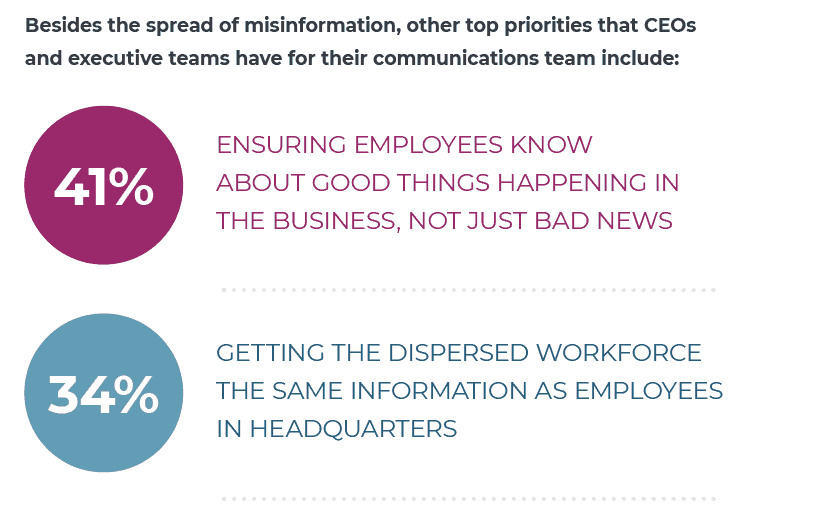
Employees expect communication to be accessible no matter where or when they work. From frontline staff to remote employees, every worker should feel connected to the organization’s mission. The challenge is sharpest at the frontline: in Firstup’s data, only 16% of hourly workers say they trust senior leadership, and 70% of managers of hourly workers say they struggle to communicate effectively with their teams. The Firstup analysis points to mobile as the unlock. Closing the reach gap with workforce communication platforms that meet hourly and deskless employees on mobile is one of the highest-leverage moves in 2026.
4: Measure communication effectiveness
Measuring internal communication is how you find out what’s actually landing. Gallup’s research has long linked engagement scores to business outcomes, with engaged teams delivering 21% higher profitability and 17% higher productivity than disengaged teams. The same logic applies to the messages that produce engagement: real-time analytics on reach, open rates, and behavior turn internal communication from a guess into an engagement strategy you can refine.
Analytics also need to be actionable. As Gallup’s engagement research emphasizes, insights on message reach, behavior, and sentiment should directly influence the next campaign, so internal communications operates as a continuous loop, not a quarterly status update.
5: Personalize your content
Personalization is one of the most powerful levers for engagement. Employees engage with content that feels relevant to their role, location, and stage in their employee journey. McKinsey’s State of Organizations work shows that targeting and personalization are now central to how high-performing companies design the employee experience, with personalized journeys producing measurably stronger engagement than one-size-fits-all messaging.
Workforce orchestration platforms automate this at scale, sending each employee content that matches their specific context, whether based on team, location, role, or milestone in their employee journey such as returning from parental leave or hitting a work anniversary, and routing it through preferred channels. McKinsey’s research consistently links that kind of contextual relevance to higher engagement.
6: Set a regular content cadence
Consistency in communication is how you keep employees informed without overwhelming them. Gallup’s longstanding work on engagement makes the case directly. Gallup’s State of the Global Workplace 2026 report puts global employee engagement at 20%, the lowest level since 2020, costing the world economy an estimated $10 trillion in lost productivity. Companies that build a steady content rhythm, with the right mix of leadership updates, team news, and operational information, see meaningfully higher engagement scores than those with sporadic, reactive communication.
Gallup’s research also shows engaged business units deliver 21% higher profitability and up to 59% lower turnover in high turnover organizations. A predictable cadence is one of the cheapest ways to capture that advantage.
7: Use video to engage
Video has become one of the most effective formats in internal communications in today’s digital workplace. According to Forbes’ research on video and consumer attention, 69% of consumers will watch an ad for a product or service they’re interested in, and 84% will watch a video to access content on a favorite site. Short, focused videos under 90 seconds keep employee attention without taxing it.
Video also creates a more personal connection between leadership and frontline employees, which matters in hybrid and distributed work. Forbes’ research suggests viewers retain significantly more from a video than from a comparable block of text, making it especially useful for safety, compliance, and change messages.
8: Vary your content
Avoiding monotony is essential for sustained engagement. Gallup’s Q12 research consistently shows that the employee experience improves when employees encounter a varied mix of formats: short videos, polls, quizzes, infographics, and clear written updates. Variety isn’t a vanity choice; it’s how internal communications stay readable across roles, languages, and shift patterns. The Gallup data also shows companies that diversify formats tend to score higher on employee experience metrics like message relevance and content usefulness.
For more details, download our State of employee engagement report here.
Promoting employee well-being and work-life balance

9: Focus on physical and mental well-being programs
Robust mental health and wellness programs, including stress management workshops, flexible schedules, and mental health days, are now table stakes for engagement. According to McKinsey’s research on workforce health, the 2026 reality is that burnout affects roughly 42% of the workforce, with 64% of employees regularly responding to notifications after hours. McKinsey’s analysis reframes the issue: workload balance is no longer a perk conversation; it’s a job-design conversation. Companies that treat physical, mental, and emotional well-being as strategic business priorities report meaningfully higher engagement and lower turnover.
10: Focus on mental health support
Mental health support is a critical element of employee engagement. McKinsey’s research on workforce health and burnout finds that employees with access to mental health resources are significantly more engaged than those without. The McKinsey Health Institute work points to a dual outcome: stress management workshops, counseling services, and protected mental health days reduce burnout, and they signal that the organization treats well-being as part of the job, not a separate program.
Enhancing leadership and managerial relationships

11: Promote leadership transparency and communication
Leadership transparency is now the single most important driver of workplace motivation, ahead of belonging and feeling valued. Gallup’s 2026 State of the Global Workplace finds that under intense technological and market pressure, employees care less about generic praise and more about strategic clarity, stability, and future job relevance. Gallup’s analysis points to a clear playbook: leaders who share updates on changes, key decisions, and challenges, in a way that closes the loop with the workforce, build the kind of leadership trust that holds teams together through change.
12: Strengthen employee-manager relationships
The direct manager remains the single most influential variable in team-level engagement. Gallup estimates that managers account for at least 70% of the variance in team engagement scores. But managers themselves are in trouble: Gallup’s data shows global manager engagement has fallen from 30% in 2022 to 22% in 2025, the steepest manager decline Gallup has tracked. Organizations that protect their managers’ time, narrow their spans of control, and equip them to coach their direct reports see better engagement scores from both managers and the teams below them.
Firstup allows us to make it happen
“The best way to reduce turnover is to increase engagement. One of the best ways to energize the team about the work they’re doing is to highlight it for the rest of the organization to see.”
13: Develop leadership programs
Deloitte’s 2026 Human Capital Trends research finds that organizations that invest in developing managers and senior leaders meaningfully outperform peers on both retention and engagement scores. The Deloitte work also points to where development investment pays off most: training programs that build coaching, feedback, and communication skills, rather than narrow technical or operational management, produce the strongest gains. Great managers don’t appear by accident; they’re trained.
14: Empower employee decision-making
Decision authority is a powerful engagement driver because it gives employees real ownership of their work. Self-determination research, summarized in Gallup’s engagement literature, identifies autonomy as a core driver of intrinsic motivation, discretionary effort, and long-term commitment. Gallup’s analysis is clear: employees who structure their own work and prioritize their own tasks consistently report higher engagement than those in tightly micromanaged roles. Pushing decision rights closer to the work is one of the cleanest ways to drive engagement.
Strengthening company culture and team collaboration
15: Strengthen company culture
A strong company culture aligned with the organization’s goals and values is a critical driver of employee engagement. McKinsey’s research on culture and performance finds that employees who feel connected to their company’s culture deliver stronger business outcomes across productivity, retention, and customer experience. McKinsey’s framing on this is direct: employer brand isn’t built by tagline; it’s built by how the company shows up to its workforce every day, in messages, decisions, and how leaders behave when no one is watching.
16: Strengthen team collaboration
Team collaboration boosts engagement by giving employees stronger peer relationships and a clearer sense of what their work contributes to. Gallup’s longstanding research on the elements of engagement includes “having a best friend at work” as a core driver, a finding that gets at the deeper point: peer relationships make the work feel meaningful. The Gallup data is consistent on this: cross-functional projects, team-building, and shared collaboration platforms all help employees build the connections that hold them through harder periods.
17: Build psychological safety in the workplace
Psychological safety is one of the most effective ways to improve engagement. When employees feel safe sharing ideas, raising concerns, and admitting mistakes, teams contribute ideas more freely, learn faster, and recover better from change. Gallup’s research consistently links psychological safety to higher discretionary effort and stronger team-level engagement scores. The Gallup framework is practical: leaders build safety by treating mistakes as information, encouraging feedback, and protecting the people who raise hard questions.
Recognition and career development opportunities

18: Recognize employee achievements
Recognition is one of the simplest and most effective engagement levers. Gallup’s research finds that employees who receive regular, meaningful recognition are three times more likely to be engaged and 44% less likely to be actively job-seeking. The Gallup data also shows that companies prioritizing recognition see roughly 31% lower turnover than peers. The catch: only 48% of employees feel their company’s recognition is genuine. To work, recognition has to be specific, timely, and tied to the work, not pulled from a script.
19: Offer career development opportunities
Career development is a key driver of engagement because it shows employees the organization values their future. 94% of employees say they’d stay at a company longer if it invested in their learning and development, according to LinkedIn’s Workplace Learning Report. The LinkedIn data points to a structural answer: companies that build transparent, skill-based progression frameworks, rather than tenure-driven promotion ladders, give employees clearer growth opportunities and meaningfully stronger retention.
20: Establish mentorship programs
Mentorship programs are a proven way to increase engagement. Gallup’s engagement research finds that employees with mentors are significantly more engaged than those without, and they’re more likely to see a long-term future at their employer. The Gallup data is consistent on the mechanism: formal programs that pair employees with experienced leaders accelerate skill building, surface stretch opportunities, and create the kind of relationship-driven development that retains high performing employees.
Implementing strategic communication practices

21: Partner with HR and IT for better tools
The tools employees use every day shape how they experience the organization. McKinsey’s research on the state of organizations finds that ineffective tools quietly drain productivity and engagement, especially in distributed and frontline environments. The McKinsey work points to a practical fix: partnering with HR and IT to invest in user-friendly platforms reduces friction, improves the employee experience, and frees managers to do their actual job.
22: Ensure seamless tech integration
Adopting new tools is one thing; integrating them well is another. Gartner’s 2026 Global Labor Market Survey found that only 27% of executives have a comprehensive AI strategy, and just 20% believe their workforce is truly AI-ready. Gartner’s data also flags a related problem: 88% of employees with enterprise AI access also use personal “shadow AI” tools to get their jobs done, a sign that current tools aren’t meeting the bar. The lesson: introduce new technology gradually, integrate it with what employees already use, and design hybrid work environments where the tool stack works as one.
23: Improve internal communication channels
Effective internal communication is one of the top drivers of engagement. Firstup’s 2026 State of Employee Engagement report found that 52% of managers, 49% of corporate office workers, and 35% of hourly employees say strong communications is the reason they feel engaged. The Firstup analysis points to channel consolidation as the lever: centralized platforms that integrate messaging, email, intranet, and mobile access make it possible to reach every employee on their preferred channel, and to do it consistently. That consistency is what turns communication into a measurable engagement strategy.
24: Use real-time analytics to improve engagement
Real-time analytics turn internal communications from a guess into a feedback loop. Firstup’s research found that 43% of corporate office workers and 37% of managers spend three or more hours a week searching for basic information they need to do their jobs, a hidden tax that engagement scores rarely capture. The Firstup data points to a clear opportunity: measuring engagement metrics like message reach, completion, and sentiment, in real time, lets communicators fix the next campaign before it lands, not after.
In an orchestration model, analytics don’t just report. They feed the next message, fine-tuning timing and channel based on engagement data and engagement scores so every communication moves behavior in the right direction.
Promoting continuous learning and development

25: Promote continuous learning and development
Continuous learning is one of the strongest drivers of engagement in 2026. Learning embedded in the daily flow of work, rather than scheduled into off-site classroom sessions, has the strongest measurable effect on engagement and retention. 94% of employees say they’d stay at a company longer if it invested in their development (LinkedIn). The LinkedIn research also points to format: a wide-open lane for personal development, in the form of certifications, workshops, skill building paths, and on-the-job learning, signals that the organization is invested in their future.
26: Engage employees through CSR initiatives
Corporate social responsibility programs that let employees give back to their communities are powerful engagement drivers. Deloitte’s Human Capital Trends research finds that employees who participate in CSR initiatives report stronger engagement and a deeper emotional connection to their employer. The Deloitte work points to mechanism over format: volunteering, sustainability projects, and community partnerships align personal values with organizational mission, which is a quiet but real engagement multiplier.
Purpose and inclusion in the workplace

27: Connect work to purpose
Employees are more engaged when they understand how their work connects to a larger purpose. Gallup’s research on meaningful work shows that employees who describe their work as meaningful are roughly four times more likely to report high engagement and are significantly more likely to remain with their employer for three or more years. The Gallup framework points to a practical role for internal communicators: connecting every announcement, every campaign, and every team update back to the mission is how purpose becomes visible day to day.
28: Foster diversity and inclusion
DEI is a meaningful driver of employee engagement. McKinsey’s research on diversity and inclusion finds that organizations with strong DEI initiatives consistently outperform peers on engagement, innovation, and financial performance. The McKinsey data is clear that ethnic diversity, gender diversity, and inclusion across roles all play a part. The deeper signal is belonging: when employees from all backgrounds feel they’re treated fairly and have equal access to growth, engagement climbs across the workforce, not just within underrepresented groups.
Using employee feedback to drive engagement

29: Regularly gather employee feedback
Employees need to feel heard and know their feedback is acted on. SHRM’s research on employee engagement consistently finds that organizations with active employee surveys, pulse surveys, and continuous feedback loops see stronger engagement than those that rely on annual reviews alone. The SHRM data points to instruments and discipline together: surveys, polls, and focus groups all help surface employee sentiment early, and sentiment analysis can pull useful signal out of qualitative feedback. The single rule: close the loop. When employees see their feedback turn into visible action, trust climbs; when they don’t, it erodes.
30: Evaluate and track employee engagement drivers
Continuous evaluation keeps your engagement strategy honest. Both Gallup and SHRM research point to the same discipline: set up periodic reviews using engagement scores, employee Net Promoter Scores (eNPS), pulse surveys, employee surveys, and behavioral analytics to measure whether your initiatives are still doing the work. Tracking the right engagement metrics over time, and adjusting based on what you find, is how engagement strategy stays connected to business results.
AI and the future of employee engagement
The biggest engagement shift of 2026 is AI. The technology has crossed from pilot into daily workflow, and the employee experience has shifted with it. Gartner’s research and Gallup’s engagement data both flag AI as a top engagement variable now, not in some future state.
AI anxiety is real and rising. Gartner’s data on worker AI fears shows concern about AI-driven job loss climbed to roughly 40% in 2026, up from 28% in 2024. Employees who fear being replaced disengage faster and resist transformation harder. Transparent communication about how AI will be used, where decisions still belong to humans, and what reskilling support exists is now an engagement requirement, not a nice-to-have.
Managers are the unlock. Gartner’s research finds that an employee’s direct manager is the single strongest predictor of whether they’ll successfully adopt enterprise AI tools, with employees in supportive teams 8.7 times more likely to say AI has transformed how their work gets done. Where managers are disengaged or unsupported, AI adoption stalls and anxiety grows.
Skills are the new currency. Gartner’s workforce research finds 63% of workers say they’d trade a 10% salary increase for guaranteed opportunities to upskill in AI and digital competencies. Continuous learning embedded in the flow of work, rather than annual classroom training, has the strongest measurable engagement effect. Organizations that publish transparent, skill-based progression paths see meaningfully stronger retention than those still running on tenure-based ladders.
The takeaway for internal communicators: AI is now an engagement driver in its own right. Treat it like one. Communicate honestly about what’s changing, equip managers to champion it, and invest in the upskilling that lets employees see a future in the AI-powered organization, not a threat.
How to use employee engagement drivers for successful business outcomes

Align engagement drivers with company strategy
To drive employee engagement effectively, align the key drivers of employee engagement with company values and strategic goals. Gallup’s engagement research is consistent on the mechanism: when engaged employees understand how their roles contribute to the organization’s success, they feel a deeper sense of purpose. Linking engagement strategy components like professional development, recognition, and feedback to broader business objectives is how both employees and the organization build toward stronger business outcomes.
Prioritize and implement employee engagement strategies
Not every organization needs to focus on the same engagement drivers. Firstup’s research underlines the value of starting with measurement: conduct an employee engagement survey or pulse survey to understand what matters most to your workforce. If employees ask for more flexibility, prioritize psychological safety and workload balance. If recognition is the gap, build there first. Targeted initiatives that address the specific needs of your workforce will drive employee engagement more reliably than wide-spread, generic programs.
Track and measure the impact of employee engagement strategies
Driving employee engagement requires continuous measurement. Use employee engagement surveys, key performance indicators, and real-time analytics to gauge how well your initiatives are working. Gallup’s engagement research points to a small handful of metrics that matter most: eNPS, message engagement, and feedback engagement give you visibility into whether your engagement strategy is producing the company culture and business results you set out to build. Tracking these engagement metrics over time lets you refine your approach and keep engaged employees aligned with company goals.
Equip leadership to drive employee engagement
Leadership is central to successful employee engagement. Deloitte’s research on high-performing organizations is clear that senior leaders who take an active role in driving engagement, by communicating consistently, recognizing work specifically, and protecting their managers from unnecessary stress, become champions of company values across the organization. Leaders who understand the importance of transparency, development, and recognition build the kind of trust that drives loyalty and retention.
Create a culture of continuous improvement
A strong company culture supports continuous feedback and continuous improvement. SHRM’s research on engagement underlines the value of regular review: gather feedback, measure the effectiveness of your engagement strategy, and refine based on insights from your workforce. The focus on continuous improvement is what keeps engagement efforts relevant as the business and the workforce change.
Conclusion
Employee engagement is the cornerstone of any thriving organization. It shapes productivity, retention, and overall business performance. In 2026, engagement isn’t a soft metric. The Firstup research is direct on this point: even highly engaged employees plan to leave at a rate of 40 to 46% inside a year if the underlying communication and management systems aren’t working. Firstup’s data makes engagement and retention two halves of the same problem.
The 30 drivers above offer a roadmap for building a connected, motivated workforce, and the AI section adds the dimension every internal communicator is now navigating. By aligning engagement initiatives with company values and adopting workforce orchestration principles like behavioral analytics, personalization, and agile alignment, you’ll create a culture where employees are not just engaged but strategically activated to drive business success in real time.
FAQ
Table of Contents
Related posts
Subscribe via Email
Subscribe to our blog to get insights sent directly to your inbox.
Related posts




Sign up to receive the latest news and resources from Firstup
Firstup delivers personalized communication and data insights to improve the employee experience at every moment that matters