

Table of Contents
Why you should care about these new research findings.
Across both sides of the Atlantic, this timely survey offers employee engagement scores that HR leaders should find reassuring. But they are not the whole story.
Firstup surveyed more than 6,200 employees across North America and the United Kingdom (spanning corporate office workers, managers, and hourly employees) to understand the real state of engagement, communication effectiveness, and retention risk in 2026. What we found should change how you’re reading your workforce data.
Engagement is high. Intent to stay is not. And the reason isn’t how employees feel about their work, it’s how reliably they’re being informed, involved, and heard. That’s a communication infrastructure problem. And it’s one HR leaders in both regions can solve.
THE HEADLINE NUMBERS
Engaged employees. Exit-ready employees. Both, at the same time!
The engagement numbers look strong across the board. In North America, 82% of corporate office workers, 89% of managers, and 75% of hourly workers describe themselves as engaged. In the UK, the picture is similar: 76% of office workers, 83% of managers, and 69% of hourly workers report feeling engaged.
Now here’s where it gets uncomfortable. Who is planning to leave in the next 12 months?
- 46% of North American managers
- 50% of UK managers
- 80% of disengaged employees in both North America and the UK
These aren’t disgruntled outliers. These are engaged employees; people who say they care about their work but are still actively considering leaving. The engagement score and the attrition risk are running in parallel. If your dashboard only shows the first number, you’re flying partially blind.
“Engagement and intent to stay are no longer aligned. Healthy scores are masking attrition risk across critical roles.”
- Firstup State of Employee Engagement Research, 2026
WHY THIS IS HAPPENING
Frequency isn’t the problem. Reliability is.
Most employees across both regions say they receive workplace updates at least once a week. Communication volume is not the issue. But volume without reliability, targeting, and confirmation of receipt creates a false sense of security for leaders, while employees quietly slip through the gaps.
The pattern is the same whether you’re in Manchester or Minneapolis.
Messages are going out, but critical information isn’t landing. And employees are interpreting unreliable communication as something more than an operational hiccup. They’re reading it as evidence of how much the organization values them.
FIVE KEY FINDINGS HR SHOULD FOCUS ON
What the data is really telling HR leaders
[1] Engagement scores are lagging indicators, not stability signals
If engagement is the primary health metric on your dashboard, you’re measuring how employees feel today. The research shows this has decoupled from whether they plan to stay. You need both signals, and right now, most HR functions only have one.
FOR NORTH AMERICA: 3% of corporate workers, 46% of managers, and 40% of hourly employees plan to job-search within 12 months despite high engagement scores.
FOR THE UNITED KINGDOM: 47–50% across roles plan to leave within the year. UK attrition intent is running even higher than in North America.
[2] Your managers are trusted…and overloaded
Across both regions, the direct manager is the most trusted source of workplace information. That trust is a real asset. But it comes with a serious structural risk: organizations are relying on managers to be the primary communication channel for policy updates, schedule changes, safety information, and compliance messaging, and managers aren’t equipped to carry that load consistently.
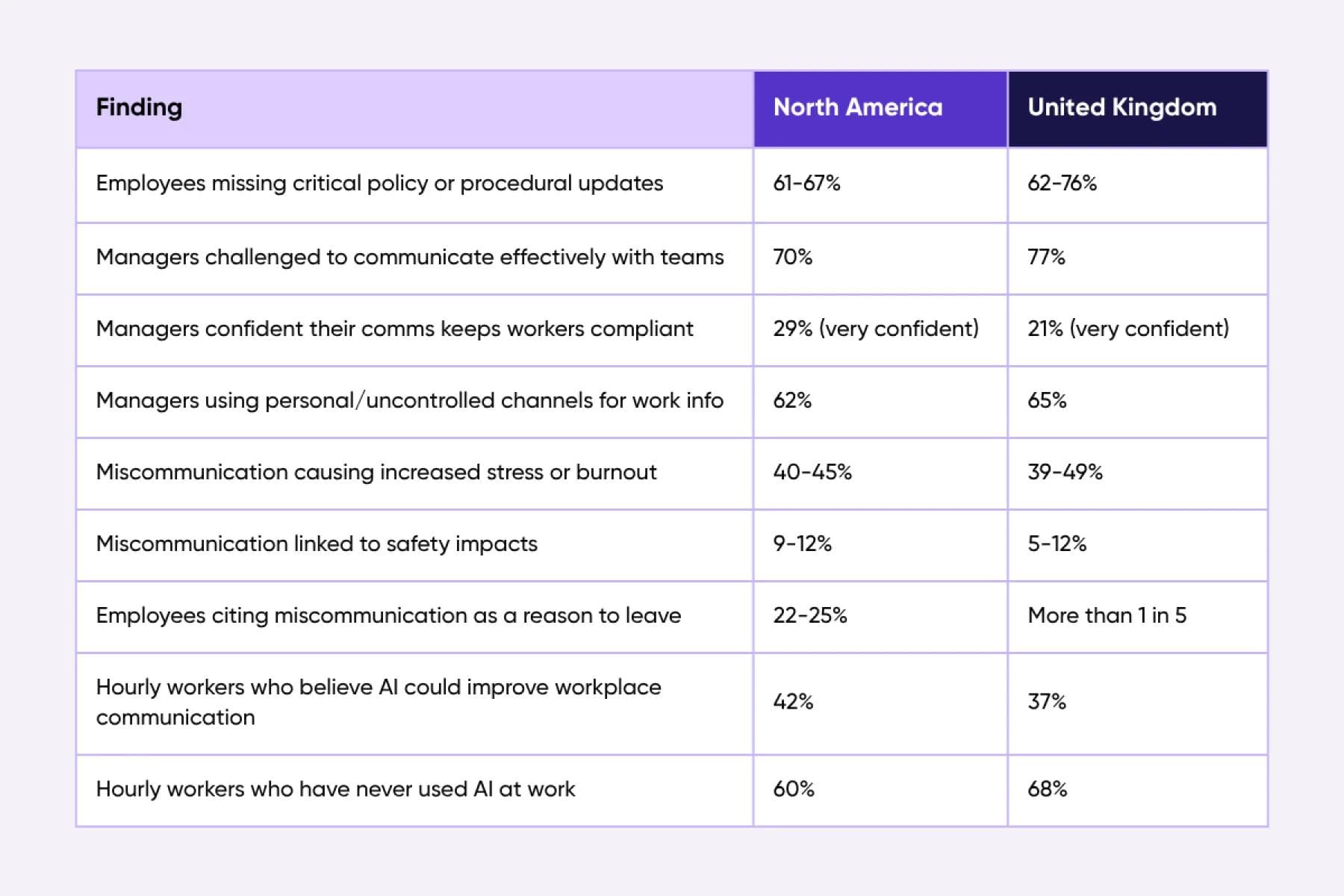
FOR NORTH AMERICA: 70% of managers report challenges communicating effectively. Only 29% feel confident their approach keeps workers compliant. Corporate leadership has just 16% trust from hourly workers as an information source.
FOR THE UNITED KINGDOM: 77% of UK managers report communication challenges (the highest across both studies). Only 21% feel very confident in compliance. Top barriers: mission alignment gaps (20%), lack of time (18%), difficulty reaching employees consistently (15%).
[3] Hourly workers are the highest-risk group and the hardest to reach
Strong communication drives engagement for roughly half of managers and corporate workers. For hourly employees, that number drops significantly. Frontline workers aren’t in email inboxes all day. When communication systems are designed for office-based employees and pushed to everyone, it’s the hourly workforce that falls through the gaps, and they notice.
FOR NORTH AMERICA: Strong communication drives engagement for 52% of managers and 49% of corporate workers, but only 35% of hourly workers. Among disengaged hourly employees, 75% don’t feel their employer cares about their well-being.
FOR THE UNITED KINGDOM: 37% of hourly workers say strong communication drives their engagement (vs. 41% of managers). 65% of disengaged hourly workers don’t feel their employer cares about their well-being, but almost the same proportion don’t trust leadership.
[4] In regulated industries, this is a governance problem
When more than six in ten managers are routing critical workplace information through personal email, SMS, and messaging apps. There is no audit trail! There is no confirmation of receipt! There is no way to demonstrate compliance. For HR leaders in healthcare, financial services, manufacturing, or any regulated sector, that’s not a communications failure; it’s a liability.
FOR NORTH AMERICA: 62% of managers use personal, uncontrolled channels. Miscommunication is tied to productivity loss (32–40%), policy gaps (29–35%), and safety impacts (9–12%).
FOR THE UNITED KINGDOM: 65% of UK managers use personal channels. Productivity loss runs at 32–38%, policy gaps at 29–36%, and safety impacts at 5–12%.
[5] AI is wanted by the people who need it most. But it is withheld from them
The narrative that frontline workers are resistant to technology is not supported by the data. In both regions, hourly employees are more likely than office-based workers to believe AI could improve workplace communication. They’re not the problem. Access is. The UK data adds a generational dimension: Gen Z workers (18–24) are the most likely group to report miscommunication-driven stress, and they prefer mobile and app-based channels that most organizations still aren’t using.
FOR NORTH AMERICA: 42% of hourly workers believe AI could improve communication (vs. 30% of corporate workers). 60% have never used AI at work; access, not attitude, is the barrier.
FOR THE UNITED KINGDOM: 37% of hourly workers vs. 29% of office workers see AI’s communication potential. 68% have never used AI at work. 49% of Gen Z workers (ages 18–24) report stress due to miscommunication ( the highest of any age group).
WHAT THIS MEANS FOR YOU
The HR function that stabilizes retention in 2026 builds infrastructure, not campaigns
The organizations that will close the gap between engagement and retention aren’t the ones that send more messages. They’re the ones that change how messages are sent, tracked, and confirmed. Here is where both regions’ data converge on clear actions:
- Track communication reliability alongside engagement. If you’re not measuring whether critical information is actually reaching employees (by role, by location, by channel) you’re managing a lagging indicator in isolation. Build delivery and receipt confirmation into your communication infrastructure.
- Reduce the burden on manager cascade. Managers are trusted, but they’re not equipped to be your primary delivery channel for policy, compliance, and safety updates. Direct, role-based, organization-controlled communication must reach employees without depending on a manual relay chain.
- Design for the frontline, not the office. Hourly workers are not a subset of your communication strategy. In most organizations, they’re the majority of the workforce. Mobile-first, targeted, timely delivery through channels employees actually use isn’t a feature; it’s the baseline requirement.
- Close the AI access gap before it becomes a wider equity gap. If the employees most affected by communication breakdowns are also the ones with the least access to the tools that could address those breakdowns, any technology strategy will underperform. Treat frontline enablement as a core part of your engagement strategy.
- For UK teams: take the Gen Z signal seriously. Younger workers are experiencing disproportionate stress from poor communication, and they want to hear from you through mobile channels. Getting ahead of this now, while Gen Z is a growing but not yet dominant part of the workforce, is far easier than retrofitting systems later.
- Treat uncontrolled channels as a compliance issue, not a habit. When managers route workplace information through personal email or messaging apps, your organization loses visibility, auditability, and control. In regulated industries, this is a risk management conversation.
“Communication reliability is tied to outcomes leaders already care about: workforce stability, productivity, compliance, and trust.”
– Firstup State of Employee Engagement Research, 2026
IN CLOSING
Engagement shows current sentiment. Communication reliability signals future risk.
The research across North America and the United Kingdom tells the same fundamental story, with local texture. Engagement is real. The pride, the effort, the connection to mission…those are genuine, and they matter. But they are not guarantees of retention. Not when nearly half of every employee group across both regions is actively contemplating a job search within the next 12 months.
What the data makes clear is that the gap between engagement and loyalty is being driven by something specific and fixable: organizations are struggling to deliver critical information consistently, reliably, and traceably across roles. That is an infrastructure problem, and it has infrastructure solutions.
The HR leaders who close this gap in 2026 will be the ones who stop measuring only how employees feel and start measuring whether critical information actually reached them, whether it was understood, and whether it changed behavior. Those are the metrics that turn engagement into retention.
Download the State of Employee Engagement report and join the discussion
Download the report for your region. Watch the webinar.
Table of Contents
Related posts
Subscribe via Email
Subscribe to our blog to get insights sent directly to your inbox.
Related posts




Sign up to receive the latest news and resources from Firstup
Firstup delivers personalized communication and data insights to improve the employee experience at every moment that matters