

Table of Contents
WEBINAR RECAP
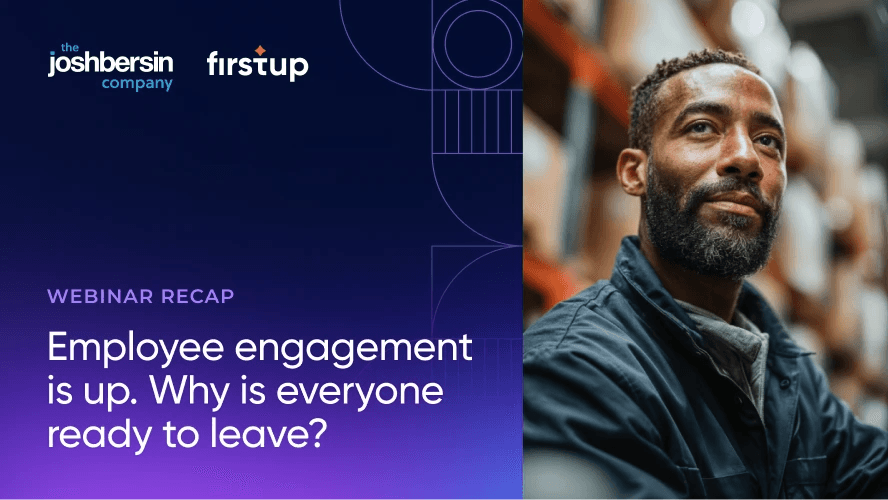
Firstup and The Josh Bersin Company unpacked a startling paradox: engagement scores are up, yet nearly half the workforce is still planning to walk out the door.
If your engagement scores are healthy, you might assume your retention risk is under control. New research from Firstup, paired with context from The Josh Bersin Company, suggests this assumption could be costing you your best people.
A webinar summary that will move you to learn more
In a recent webinar, Firstup VP of Product Marketing Mike Vilimek and Julia Bersin, Director of Research at The Josh Bersin Company, shared original survey data from more than 3,100 employees across the U.S. and Canada.
The findings challenge one of HR’s most trusted metrics.
Below is a quick recap of the most important points, but you can always watch the complete on-demand discussion here:
https://firstup.io/webinars/engagement-is-up-why-is-everyone-ready-to-leave/
The engagement paradox, based on new Firstup research
The top-line numbers look reassuring: across corporate employees, managers, and hourly workers, engagement rates came in at 82%, 89%, and 75%, respectively. But the story doesn’t end there.
Among those same engaged employees, 43% of corporate workers, 46% of managers, and 40% of hourly workers say they’re likely to look for a new job in the next twelve months. For disengaged employees, that number surges to around 80%.
The conclusion is uncomfortable: engagement and intent to stay have decoupled. You can have a workforce that scores well on annual surveys and still be sitting on significant, invisible retention risk.
“Engagement reflects how people feel about their work today. It doesn’t predict whether they’re planning to stay.”
— Mike Vilimek, VP, Product, Solutions & Alliances Marketing, Firstup
When Firstup dug into the “why,” one theme dominated: communication. Despite most employees receiving updates at least weekly, 61–70% across all three groups still report missing a critical policy or procedure update. The problem isn’t volume, it’s delivery. Too many messages, the wrong channels, and no reliable way to reach certain employee populations. Sending more won’t fix it.
The cost shows up in hard metrics: 40–45% of employees report stress or burnout tied directly to miscommunication, and 22–25% say poor communication is actively driving them to look for a new job. In healthcare, manufacturing, and logistics, 9–12% of managers and hourly workers say miscommunication has negatively affected their safety. This is a compliance and risk problem, not a soft one.
What The Josh Bersin Company is seeing
Julia Bersin brought a broader lens to these findings, and the external data reinforces why the engagement paradox is happening now.
Gallup’s latest numbers show that, for the first time in roughly four years, the share of U.S. workers who are struggling has surpassed those who are thriving. University of Michigan consumer sentiment has hit a roughly 60-year low. The Edelman Trust Barometer is signaling a widening global crisis of institutional trust.
The throughline: how people feel outside of work shapes how stable and committed they feel inside it. Engagement surveys can’t capture that context, and Bersin’s research suggests nearly half of employees don’t feel comfortable being fully honest in those surveys anyway.
Her bigger point is that engagement, as a standalone metric, isn’t actionable. It tells you sentiment but not cause. It doesn’t reveal whether employees have the tools they need, feel included, or trust leadership. Organizations that want to move the needle need to go a layer deeper.
“Organizations that listen to employees, hear and understand them, and act accordingly see much greater outcomes across the board.”
— Julia Bersin, Director of Research, The Josh Bersin Company
Trust is the metric that actually moves the needle
Bersin’s firm tracks 24 dimensions of employee experience, and the data is clear: trust in the organization is the highest-impact cluster of all. Companies that score well on trust-related practices—transparent leadership communication, integrity, and embedding mission and purpose into day-to-day interactions—outperform peers on financial performance, adaptability, innovation, and retention.
When Bersin’s team asked organizations to describe their employee experience in a single word, the most common answer was “inconsistent.” “Fragmented” and “sporadic” came up frequently, too. That inconsistency is felt most acutely by frontline and deskless workers, who are both less likely to be covered by best-practice EX programs and less likely to have access to next-generation communication technology that could close the gap.
The irony Bersin flagged: the industries that most need intelligent communication platforms—manufacturing, logistics, healthcare, retail—are the least likely to have them. Deskless industries trail desk-bound industries significantly in both EX maturity and access to modern communication tools.
Communication without listening is only half the loop
One of the sharpest observations from both Bersin and Firstup: most organizations treat communication as one-directional. Leadership pushes information out; employees receive it. But that model misses the other half of what makes communication work.
Bersin’s research shows that organizations that build genuine listening into the employee experience—not just annual surveys, but continuous feedback loops, open dialogue, and space for employees to surface ideas in the flow of work—see dramatically better outcomes. Bersin calls this employee activation: a cycle of listening, openness, and continuous action-taking that goes well beyond pulse surveys.
Intelligent communication platforms enable this kind of multidirectional exchange. They don’t just deliver content, they create the infrastructure for employees to respond, contribute, and feel heard. That feedback loop, Bersin argues, is what actually builds the trust that drives retention.
The manager caught in the middle
Both Firstup and Bersin converged on the same structural problem: managers are the most trusted information source for employees—more than 40% of workers across all roles name their direct manager as their primary trusted channel—yet managers are stretched thinner than ever.
Bersin introduced the concept of the “super manager”: a people leader who, with the right AI-powered tools, can be more effective without adding to their workload. The opportunity isn’t to pile more onto managers’ plates. It’s to free up their bandwidth by automating the routine—scheduling, information delivery, nudges—so they can focus on what only a human can do: build trust, support their teams, and surface what’s actually happening on the ground.
The AI opportunity and the access gap
One of the more counterintuitive findings from Firstup’s research: 42% of hourly workers believe AI could improve workplace communication, a higher rate than corporate employees. Frontline workers see the potential clearly. And yet 60% of those same workers have never used AI at work, with 64% citing lack of access—not skepticism—as the barrier.
Bersin’s framing: AI creates both the opportunity and the urgency for personalized, real-time communication. So much is changing so fast that employees need relevant, timely information to stay grounded and productive. AI-powered platforms can deliver that at scale across mobile-first frontline populations, across time zones, integrated with existing HR systems.
Firstup recently launched AI Search to help address this directly, putting intelligent, cross-system search in the hands of frontline workers through the Firstup mobile app, with connections into systems like Workday and UKG. The goal: make it as easy for a frontline employee to find what they need as it is for a desk-based worker.
5 things the data tells us
1. Engagement scores are masking attrition risk. High engagement and high turnover intent coexist more often than leaders realize.
2. The communication problem is delivery, not volume. Targeted, relevant, channel-appropriate communication moves the needle. More messages don’t.
3. Trust is the metric that predicts outcomes. Bersin’s research shows trust-related EX practices are the highest-impact dimension across business, people, and innovation outcomes.
4. Managers need infrastructure, not more responsibility. They’re the most trusted channel and the most overloaded. AI tools can restore their capacity to lead.
5. Frontline workers are your highest-risk, least-served population. They’re most open to AI, least likely to have access to it, and most exposed to communication-driven compliance risk.
Building a case for change when the engagement data looks fine
A common question from the live webinar attendees: How do you justify investing in communication infrastructure when leadership is pointing to healthy engagement scores?
Bersin’s answer: flip the question. Ask what those scores are actually telling you and what they’re not. Are employees satisfied with career opportunities? Do they feel heard? High engagement buys you time; it doesn’t buy you stability. And it doesn’t eliminate compliance risk.
Vilimek added a practical anchor: safety and regulatory requirements don’t pause for good sentiment scores. In healthcare, manufacturing, and other regulated industries, communication infrastructure has a measurable impact on patient outcomes, safety incidents, and compliance exposure—regardless of how engaged employees feel on the day of the survey.
Go deeper: watch the webinar and read the reports
This blog can only tell part of the story. Explore the information here:
- On-demand webinar: “Employee engagement is up. Why is everyone ready to leave?”
- New research report: “The state of employee engagement in North America.”
- Bersin Report: People management in the Age of AI: The Rise of the Supermanager
- Bonus: “The state of employee engagement in the United Kingdom.”
Table of Contents
Related posts
Subscribe via Email
Subscribe to our blog to get insights sent directly to your inbox.
Related posts



Sign up to receive the latest news and resources from Firstup
Firstup delivers personalized communication and data insights to improve the employee experience at every moment that matters