

Table of Contents
There's a contradiction at the center of manufacturing communication, and most organizations don't see it until something goes wrong. Manufacturers are communicating constantly. Updates go out daily. Supervisors hold shift briefings. Emails get sent. Bulletin boards get posted. Yet, 79% of frontline factory workers have learned about a policy, procedure, or safety update only after it had gone into effect. The problem isn't volume. It's whether the right message is reaching the right worker at the right time and whether anyone knows when it isn't.
To understand exactly where communication breaks down, Firstup surveyed 1,000 U.S. frontline manufacturing workers across different roles and industries. We asked about real operational consequences. What they told us was striking.
Frequency isn’t the problem. Relevance is.
Fifty-eight percent of manufacturing employees say the updates they receive are only "somewhat relevant" or “not relevant at all”. When workers are regularly receiving updates that don't apply to their role, their line, or their shift, the natural response is to start tuning them out. And 48% say they do exactly that, sometimes even when they suspect the information is important.
The reasons workers give are practical: 31% say updates don't feel relevant to their specific role or line. Twenty-three percent say they don't have time during their shift. Fifteen percent say there are simply too many messages to keep up with.
When messages don't land, the consequences are operational
The report makes clear that this isn't an engagement problem. It's an operations problem.
Seventy-one percent of workers have experienced production or safety issues tied to miscommunication or a lack of communication from a manager or senior leader. Those consequences include:
- 29% have experienced production delays or quality issues caused by missing or unclear information
- 19% have made errors in operating equipment or following procedures
- 12% have been involved in a workplace injury or near-miss linked to an outdated or unknown safety procedure
- 9% have been part of a failed audit or compliance issue tied to a missed update
Safety is where the margin gets thinnest. Nearly 1 in 5 workers (19%) have missed a safety protocol or hazard update, 14% have missed OSHA or compliance-related information, and more than half (55%) aren't fully confident that their employer's communication approach actually keeps them informed and compliant.
In an industry that accounts for 15% of workplace injuries despite employing only 8% of the U.S. workforce, the cost of a missed safety message isn't abstract.
The supervisor relay problem
Managers and supervisors are the single most relied-upon communication channel on the factory floor, cited by 48% of workers. That's not surprising. Supervisors are present in the flow of work in a way that email, portals, and bulletin boards simply aren't.
But this creates a fragile system.
When critical information depends on individual handoffs—who remembered to say what, in which huddle, to which crew, on which shift—consistency becomes a function of recall and availability rather than reliable infrastructure. Supervisors already manage labor coverage, production targets, quality issues, safety expectations, and increasingly complex technology rollouts. Adding "primary communication conduit for the entire facility" to that list creates hidden risk at scale.
The report bears this out. Seventy-seven percent of workers have experienced workplace issues such as increased stress, reduced collaboration, or feeling undervalued or disconnected, due to miscommunication from a manager or senior leader. Twenty-one percent say poor communication has made them want to leave their current facility, and 15% say it has made them want to leave manufacturing entirely.
In an industry facing a potential shortfall of 1.9 million workers through 2033, preventable communication friction is a retention problem manufacturers can no longer afford to ignore.
Twenty-one percent say poor communication has made them want to leave their current facility.
Automation is making the problem more urgent
Communication gaps now extend beyond safety and compliance into digital transformation. As automation and AI reshape manufacturing, workers are increasingly expected to adopt technologies they haven't been equipped to understand or use.
Nearly half of workers (49%) never use AI in their role at all. Among those who rarely or never use it, 53% say it's because they don't have access. Another 11% have access but no training.
That gap matters because workers aren't opposed to technology. Thirty-six percent believe AI could improve their productivity, and 35% believe it could improve their efficiency, like AI solutions that deliver instant answers to questions and ensure they receive highly personalized information at the right time via the right channel in order to perform their job more effectively and safely.
What "better" looks like
The research points to five practical shifts manufacturers can make:
- Target by role, line, shift, and location. When workers receive irrelevant information, the important updates become harder to find.
- Make critical information easier to find during the flow of work. Twenty-three percent of workers spend at least 15 minutes searching for safety procedures, equipment manuals, or policy updates, or give up entirely. In manufacturing, time spent searching is downtime.
- Equip supervisors to communicate clearly and consistently. Supervisors should reinforce critical information, not serve as the primary communication channel across shifts, crews, and sites.
- Build visibility before missed updates become operational problems. It’s not enough to know that a message was sent. Manufacturers need to know it was received, understood, and acted on before it shows up as a safety incident, a failed audit, or inconsistent execution on the floor.
- Treat automation as change management. Technology rollouts require more than training. Workers need to understand what's changing, why it matters, how it affects their role, and what support is available before concern hardens into resistance.
It’s a gap worth closing
Manufacturers have spent years making production more measurable, consistent, and controlled. Every process has an owner, a standard, and a way to verify it ran correctly. Workforce communication has never been held to that standard. Our research suggests that the assumption—that messages are reaching the people who need them—is wrong more often than most organizations realize. And that the consequences are showing up in places leaders already monitor closely.
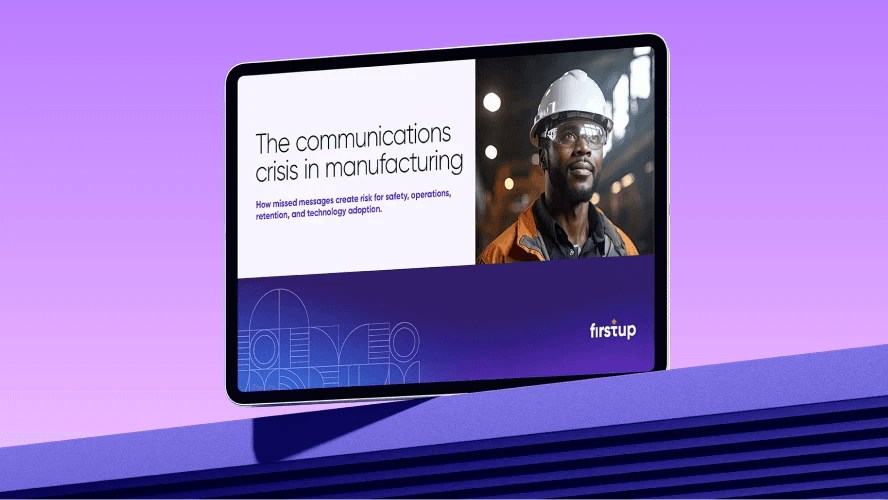
The Communications Crisis in Manufacturing
How missed messages create risk for safety, operations, retention, and technology adoption
Table of Contents
Related posts
Subscribe via Email
Subscribe to our blog to get insights sent directly to your inbox.
Related posts




Sign up to receive the latest news and resources from Firstup
Firstup delivers personalized communication and data insights to improve the employee experience at every moment that matters